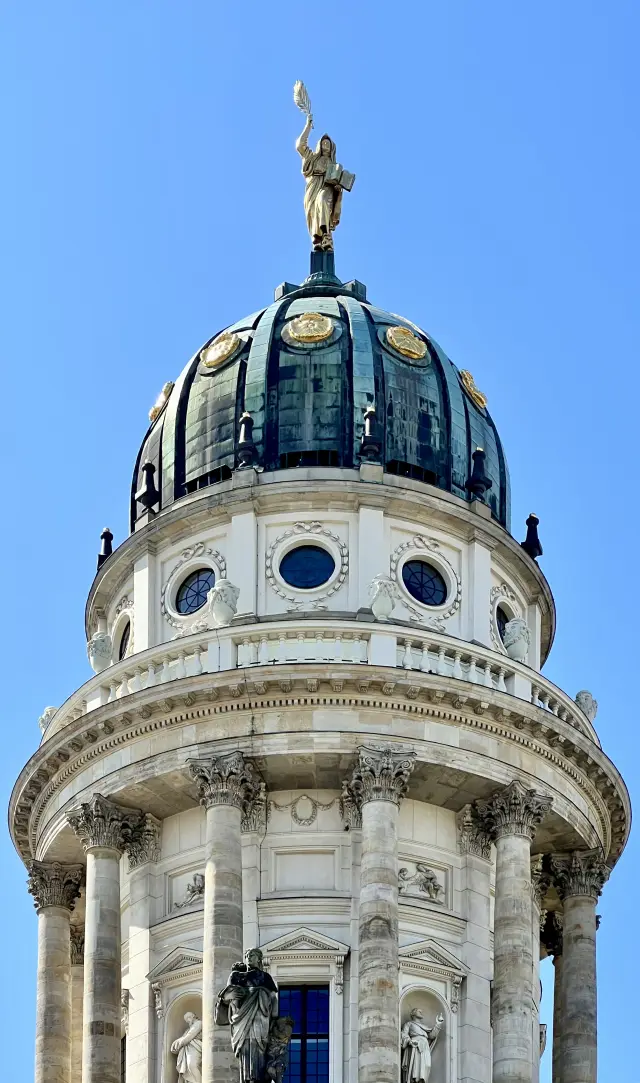
Berlin wears its history openly in stone, copper and bronze: a gilded figure above the Gendarmenmarkt, a poet among four allegories, a dragon-slayer on the banks of the Spree, a sea god in front of the Red City Hall (Rotes Rathaus), a quadriga on the Brandenburg Gate and a golden goddess of victory high above the Tiergarten. Anyone who knows these six figures reads the city differently — as a sequence of building, loss, return and new beginnings.
Two routes to the same figures
The first route orders by place: which monuments stand on the Gendarmenmarkt, which in the Nikolaiviertel, which between the Brandenburg Gate and the Victory Column — and how they can be joined up on foot in a single day. The second route orders by theme: which figures disappeared for decades and came back, which were planned for a different city from the one in which they stand today, and which can now be questioned in a voice of their own.
Both routes lead to the same six figures but tell them differently. Those visiting Berlin for the first time are best off starting with the places. Those who already know the city and want to understand more deeply what its monuments went through in the 20th century should start with the themes.
Berlin in six figures — the timeline
The dates below come from the monument database of the Berlin State Monument Office and from the sources named on the individual pages. What stands out: almost every figure has two dates — one for its creation and one for its return.
- 1780 – 1785The domed towers on the Gendarmenmarkt are built to plans by Carl von Gontard and completed under Georg Christian Unger; since then the gilded allegory of Religion, which Berlin calls “Nike”, has stood on the French Cathedral (Französischer Dom).
- 1790 – 1793The quadriga after Johann Gottfried Schadow is beaten in copper by Emanuel Jury and set up on the Brandenburg Gate.
- 1806Napoleon has the quadriga taken to Paris as war booty; in 1814 it returns, supplemented with the Iron Cross and the Prussian eagle after Karl Friedrich Schinkel.
- 1818 – 1821Schinkel builds the Schauspielhaus, today’s Konzerthaus, on the axis of the two domed towers.
- 1853 – 1855August Kiss creates Saint George fighting the dragon; the bronze initially stands in the first courtyard of the Berlin Palace (Stadtschloss).
- 1859 – 1869Foundation stone of the Schiller Monument on the poet’s 100th birthday; Reinhold Begas wins the competition in 1864, and the monument is completed by 1869.
- 1865 – 1873The Victory Column after Heinrich Strack is built on the Königsplatz, crowned by Friedrich Drake’s gilded Victoria — the Goldelse.
- 1888 – 1891Reinhold Begas’ Neptune Fountain is cast and inaugurated on the Schlossplatz on 1 November 1891.
- 1935The Schiller Monument is dismantled for the redesign of the Gendarmenmarkt; the figure stands in the Lietzenseepark until 1987.
- 1938 – 1939The Victory Column is moved from the Königsplatz to the Großer Stern for Albert Speer’s rebuilding plans, and its shaft is raised by one drum.
- 1945War and destruction strike almost all six figures; hardly anything of the quadriga survives, and the reliefs of the Victory Column are removed.
- 1950 – 1951The war-damaged Palace is blown up and cleared away; the Neptune Fountain and Saint George lose their places and are put into storage or relocated.
- 1957The quadriga is recreated from a plaster cast and stands on the Gate again.
- 1969The Neptune Fountain is re-erected in front of the Red City Hall, on the occasion of the completion of the TV Tower.
- 1979 – 1987The Nikolaiviertel is rebuilt; in 1987 Saint George returns to the banks of the Spree, and the reliefs of the Victory Column are put back in place.
- 1988The Schiller Monument stands on the Gendarmenmarkt again.
- 1992During the restoration of the Brandenburg Gate, the quadriga gets its Iron Cross and eagle back.
- 2026The Mitte district office is restoring the Neptune Fountain; completion is planned by the end of 2026.
How this guide works
All texts rest on publicly documented facts about year of construction, history of location and damage. Each page carries an “At a glance” box, a timeline and, at the end, a list of sources; footnotes in the text lead straight there. Where sources differ, the more cautious version is given — and where the Berlin State Monument Office does not give a number, this guide gives it only with reference to another source.
Difficult chapters — war, destruction, politically motivated relocation — are told factually, never as a game. Each page ends with the way to its figure on berlinike.art, where it answers in its own voice: a complement to the visit on site, not a substitute for it.
Frequently asked questions
How much time do you need for all six figures?
Half a day is enough for the round without climbing the towers; with the French Cathedral and the Victory Column it becomes a full day. The Gendarmenmarkt and the Nikolaiviertel are twenty minutes’ walk apart; from the Brandenburg Gate to the Victory Column it is a good two kilometres through the Tiergarten.
Does visiting the monuments cost admission?
No. All six figures stand freely accessible in public space. Admission is charged only for the viewing balustrade and the Huguenot Museum in the French Cathedral and for the platform of the Victory Column.
Is the golden figure on the French Cathedral really a Nike?
Officially not: the Berlin State Monument Office describes her as an allegory of triumphant Religion after designs by Daniel Chodowiecki. “Nike” is her Berlin name, because the raised palm branch recalls the ancient goddess of victory. This guide gives both readings.
Ask Nike yourself →Where do the details in this guide come from?
From the monument database of the Berlin State Monument Office, from press releases of the Mitte district office, from the institutions themselves and, where the office is silent, from specialist literature and Wikipedia. Each page lists its sources at the end; footnotes in the text jump straight there.
What does it mean that the figures “speak”?
Each of the six figures can be questioned on berlinike.art by voice or text and answers from its documented history — openly named as a construction, no substitute for a visit on site.
Ask Schiller yourself →Two paths, six figures
- MonumentsBerlin's monuments by place — Gendarmenmarkt, Nikolaiviertel, Tiergarten
- HistoryBerlin's history by theme — what vanished, what was moved, who speaks today
- Art historyThe paintings behind our figures — documented, with work data, timeline and primary sources
Monuments — the pages
- Page 1Discovering Berlin’s Monuments — a Guide for the First VisitWhere Berlin-Mitte’s most important monuments stand and how the Gendarmenmarkt, Nikolaiviertel and Tiergarten fit into one day on foot.
- Page 2The Gendarmenmarkt — Schiller and the Golden NikeThe Schiller Monument by Reinhold Begas and the gilded dome figure of the French Cathedral — documented history, timeline, visiting tips.
- Page 3Gendarmenmarkt Christmas Market 2026 — opening hours, entry and what to seeGendarmenmarkt Christmas market, 23 Nov–31 Dec 2026: hours, €2 entry (children and disability card free) per the organiser, how to get there.
- Page 4What to do in Berlin in December? Ideas around Gendarmenmarkt and MitteBerlin in December: Gendarmenmarkt Christmas market, view from the French Cathedral, Nikolaiviertel, Brandenburg Gate, Victory Column — ideas for Mitte.
- Page 5With Friends Through Berlin Mitte: a Monument WalkBerlin Mitte on foot as a pair or with friends: Gendarmenmarkt, Schiller, Nikolaiviertel — small tasks on the way and phone conversations with the figures.
- Page 6Nikolaiviertel and Old Berlin — George and NeptuneSaint George on the Spree and the Neptune Fountain at the Red City Hall — two bronzes that came back. Documented history, timeline, tips.
- Page 7Brandenburg Gate and Tiergarten — Victoria and GoldelseThe Quadriga on the Brandenburg Gate and the gilded Victoria on the Victory Column — documented history, dimensions, timeline, tips.
History — the pages
- Page 1Experiencing Berlin’s history — when monuments tell their storyHow Berlin’s monuments survived war, division and reconstruction — six figures that vanished, were relocated and came back.
- Page 2Vanished and returned — monuments Berlin lost and found againSaint George, the Neptune Fountain, the Quadriga and the Schiller Monument spent years away from home — four documented stories with sources.
- Page 3Built for a different city — how monuments changed their placeThe Victory Column moved in 1938/39, the Neptune Fountain in 1969 onto the TV Tower’s axis — how city planning relocates monuments.
- Page 4Voices of the city — who still speaks to you todaySix Berlin monuments in conversation: voices reconstructed from documented facts — what this approach offers, where it ends and how to use it on site.
Art history — the pages
- Page 1Art history behind the figures — historical paintings of Nike, George, Neptune, Schiller, Victoria and GoldelseArt history's most famous paintings for each speaking figure of BerliNike, from Raphael to Anton von Werner — with painter, year, collection and sources.
- Page 2Saint George in art — Raphael, Carpaccio, Rubens and MoreauHow Raphael, Carpaccio, Rubens and Moreau painted Saint George's fight with the dragon — work data, legend, timeline, sources, and the Berlin George.
- Page 3Neptune in art — Rubens, Tiepolo and Walter CraneRubens, Tiepolo and Walter Crane paint the sea god — with work data, sources and the story behind Berlin's Neptune Fountain.
- Page 4Friedrich Schiller in portraits — Graff, Simanowiz and KügelgenThree portraits that shaped the poet's image — Graff, Simanowiz, Kügelgen — with work data, sources and the story behind Berlin's Schiller Monument.
- Page 5Victoria and the Brandenburg Gate in art — Meynier and KirchnerMeynier's “Entry of Napoleon into Berlin” (1810) and Kirchner's “Brandenburg Gate” — work data, sources and the Quadriga's path from Schadow to 1958.
- Page 6Goldelse and the Victory Column in art — Anton von Werner and Lesser UryAnton von Werner's “Struggle and Victory” (1874) and Lesser Ury's Tiergarten avenue (c. 1925) — with work data, sources and the story of Drake's Victoria.
- Page 7The golden Nike and Gendarmenmarkt in art — Fechhelm and HasenpflugFechhelm's views of 1785 and 1788 and Hasenpflug's “Gendarmenmarkt” of 1822 — with work data, sources and the story of the figure on the dome.