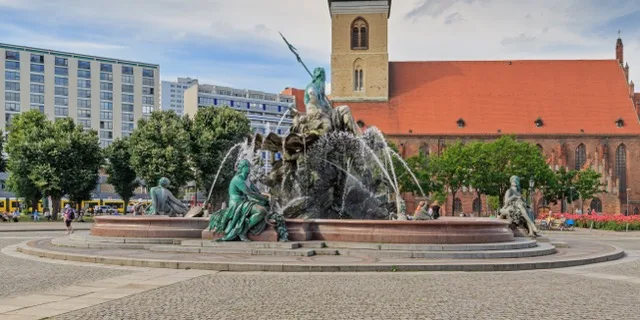
History books tell Berlin’s past in dates. The city’s monuments tell it differently: in scars, gaps and returns. Look closely and you will find on almost every well-known Berlin figure traces of what this city went through in the twentieth century — destruction, relocation, reconstruction, sometimes deliberate reinterpretation too. This section of the guide approaches that history not through places but through three questions.
Why monuments are the most honest witnesses
A monument cannot be rewritten like a text. It bears its damage visibly, its new location measurably, its missing decades as a documented gap. If a figure stood in a public park for thirty-seven years, that cannot be talked away — it is in the files of the Berlin State Monument Office (Landesdenkmalamt) and often still in the structure of the plinth. This incorruptibility makes monuments an especially direct way into the history of a city that was almost completely rebuilt twice in the twentieth century: once through war and destruction, once through decades of division.
The key dates of this story
- 1806Napoleon has the Quadriga taken from the Brandenburg Gate to Paris — the first loss, eight years before the first return.
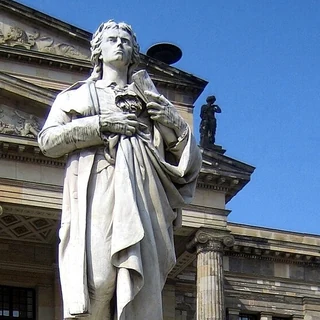
- 1935 – 1936The Schiller Monument is dismantled for the redesign of the Gendarmenmarkt.
- 1938 – 1939The Victory Column is relocated for Albert Speer’s axis and raised by one drum.
- 1944 – 1945The dome of the French Cathedral (Französischer Dom) and the Quadriga are destroyed; the reliefs of the Victory Column go to France.
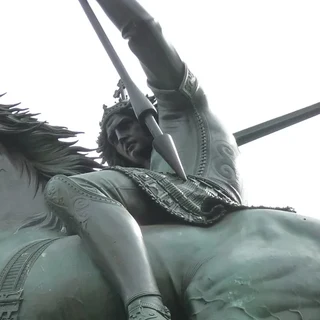
- 1950 – 1951The Berlin Palace (Stadtschloss) is blown up; George and the Neptune Fountain lose their place.
- 1957 – 1958The Quadriga is recreated from a plaster cast — cast in West Berlin, on behalf of East Berlin.
- 1969The Neptune Fountain stands again, in front of the Red City Hall (Rotes Rathaus).
- 1987George returns to the bank of the Spree, the dome of the French Cathedral is rebuilt, the reliefs of the Victory Column are back in place.
- 1988The Schiller Monument stands on the Gendarmenmarkt again, after an exchange of cultural property between East and West.
- 1991 – 1992The Quadriga gets its Iron Cross and eagle back.
- 2026The Neptune Fountain is restored.
Three questions, three paths through this section
What vanished and came back? Several of Berlin’s best-known figures were absent from their present place for years or decades — put into storage, set up in a park, carried off to another country or divided between the two halves of the city. The second page of this section tells these stories: George, who stood in Volkspark Friedrichshain for 37 years, the Neptune Fountain, which lay in a depot for 18 years, the Quadriga, which survived Paris and the war, and the Schiller Monument, whose figure was stored in West Berlin and whose allegories were stored in East Berlin.
What was built for a different city? Some monuments do not stand in their original place because later town planners had their own ideas of what Berlin should look like — and relocated figures, raised them or set them in new axes. The third page tells of the Victory Column, which was moved in 1938/39 for the “World Capital Germania”, of the Neptune Fountain, which was placed on the axis of the TV Tower in 1969, and of the domed towers on the Gendarmenmarkt, which a king had built on a Roman model.
Who still speaks to us today? Some of these figures can now not only be visited but also questioned — in a reconstructed voice of their own, telling their story from within their particular history. The fourth page presents this approach, honestly named for what it is.
An honest look at difficult chapters
Not every story a monument carries is an easy one. The Victory Column was erected for three wars and used by the National Socialists as a landmark of their axis. The Quadriga was Napoleon’s loot and was smashed in 1945 in the battle for the city. The Schiller Monument vanished in 1935 from a square that was to become a parade ground. This guide treats such chapters factually and without trivialising them: history here is not turned into a game but into the subject of serious engagement — even if the approach, a walk or a conversation with a figure, may be designed to be enjoyable.
How this section came about
The texts rely on publicly accessible, documented information: the monument database of the Berlin State Monument Office, press releases of the Mitte district office, the information provided by the institutions themselves and, where the authorities are silent, specialist literature and Wikipedia. Where sources give different details — for instance the year the Schiller Monument was dismantled or the weight of Goldelse — the more cautious version is given here, or both with a note. The aim is a guide that remains historically accurate and at the same time tells its story clearly: not a travel brochure that smooths over history to make it sound more attractive.
Frequently asked questions
Which Berlin monuments were missing for a time?
Saint George stood in Volkspark Friedrichshain for 37 years, the Neptune Fountain lay in a depot for 18 years, the Quadriga was in Paris from 1806 to 1814 and was destroyed in 1945, the Schiller Monument was absent from the Gendarmenmarkt from 1935 to 1988.1235
Ask George yourself →Which monuments were relocated by town planners?
The Victory Column moved in 1938/39 from the Königsplatz to the Großer Stern for Albert Speer’s axis and was raised in the process; the Neptune Fountain was placed on the axis of the TV Tower and the Red City Hall in 1969.24
Ask Goldelse yourself →What happened to the Berlin Palace in 1950/51?
How does this guide deal with difficult chapters?
Factually and without trivialisation. The Victory Column and Speer, the Quadriga as loot and war loss, the dismantling of the Schiller Monument in 1935 are told as history, not as a game; where sources differ, the more cautious figure is given, or both with a note.
Sources and references
- Berlin State Monument Office (Landesdenkmalamt) — monument database, statue Schiller Monument (object no. 09060093)
- Berlin State Monument Office (Landesdenkmalamt) — monument database, Neptune Fountain (object no. 09011281)
- Berlin State Monument Office (Landesdenkmalamt) — monument database, Brandenburg Gate (object no. 09065019)
- Berlin State Monument Office (Landesdenkmalamt) — monument database, Großer Stern with Victory Column (object no. 09050419)
- Berlin State Monument Office (Landesdenkmalamt) — The Nikolaiviertel
- Mitte district office — press release no. 116/2026: restoration of the Neptune Fountain
The pages in this section
- Page 1Vanished and returned — monuments Berlin lost and found againSaint George, the Neptune Fountain, the Quadriga and the Schiller Monument spent years or decades away from where they stand today — four documented …
- Page 2Built for a different city — how monuments changed their placeThe Victory Column moved in 1938/39 for Speer’s axis and was made taller, the Neptune Fountain shifted in 1969 onto the axis of the TV Tower, the domed …
- Page 3Voices of the city — who still speaks to you todaySix Berlin monuments can today not only be visited but questioned in a voice of their own, reconstructed from documented facts — what this approach can …