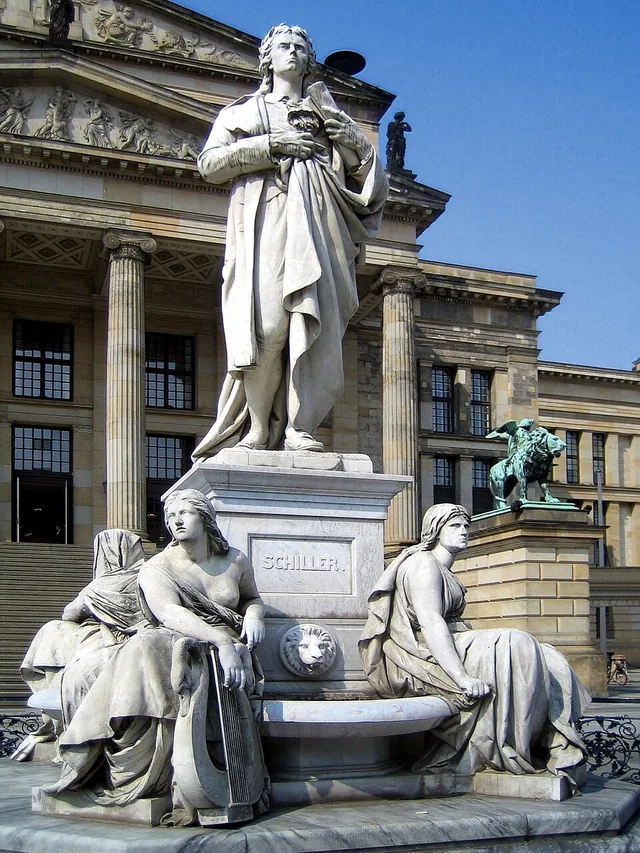
Anyone visiting Berlin for the first time soon faces a question: where to begin? The city has hundreds of monuments, yet six figures together tell almost the whole history of Berlin in the 19th and 20th centuries — and they lie so close to one another that they can be joined up in a single day on foot and with two S-Bahn journeys. This section of the guide orders them by place: Gendarmenmarkt, Nikolaiviertel, Brandenburg Gate and Tiergarten.
Why these six in particular
The selection follows a pattern that only becomes apparent once you have seen all six: each of these figures once lost its place and found it again — or, like the Goldelse, was moved and enlarged by its own side. The Schiller Monument was missing from the Gendarmenmarkt for half a century, divided between East and West. George and Neptune stood at the Berlin Palace (Stadtschloss) and had to make way when it was blown up. The quadriga was stolen once and destroyed once. The Victory Column stands today on a square that would not exist in this form without the National Socialists’ rebuilding plans. And the dome figure of the French Cathedral (Französischer Dom) lost the dome beneath her in 1944 and only got it back in 1987.
Those who visit the six therefore see not just monuments but what a city does with its monuments: erecting, moving, taking away, bringing back, reinterpreting.
The three places in brief
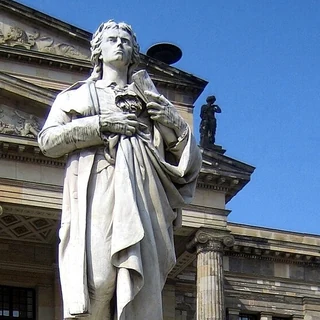
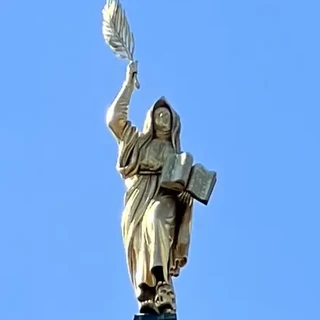
Gendarmenmarkt. The square was laid out from 1773 at the wish of Frederick II; the two domed towers were added between 1780 and 1785, Schinkel’s Schauspielhaus between 1818 and 1821.12 Here stand the Schiller Monument by Reinhold Begas with its four allegories and, high up on the French Cathedral, the gilded figure that Berlin calls “Nike” — officially an allegory of Religion. The tower offers a viewing balustrade and the Huguenot Museum.3
Nikolaiviertel. The oldest quarter of the city, rebuilt between 1979 and 1987.4 On the banks of the Spree, Saint George by August Kiß marks the entrance; in the green space in front of the Red City Hall (Rotes Rathaus) stands the Neptune Fountain by Reinhold Begas, inaugurated on the Schlossplatz in 1891 and here since 1969.5 In 2026 the fountain is scaffolded for restoration.6
Brandenburg Gate and Tiergarten. The Gate by Carl Gotthard Langhans, opened in 1791, carries the quadriga after Johann Gottfried Schadow with the goddess of victory Victoria.7 A good two kilometres to the west, at the Großer Stern, stands the Victory Column with Friedrich Drake’s gilded Victoria, the Goldelse — there since 1938/39, previously on the Königsplatz in front of the Reichstag.8
One day, six figures — the proposal
- 9:30Gendarmenmarkt: walk around the Schiller Monument, look for the four allegories and their attributes; then raise your eyes to the dome figure of the French Cathedral.
- 10:30French Cathedral: 284 steps to the viewing balustrade, then the Huguenot Museum in the tower.
- 12:00On foot along Unter den Linden, across the Schlossbrücke (Palace Bridge) and the Museum Island into the Nikolaiviertel; lunch break in the lanes around the Nikolaikirche.
- 13:30Saint George on the banks of the Spree, then the Neptune Fountain in front of the Red City Hall — behind scaffolding in 2026.
- 14:30S-Bahn from Alexanderplatz to the Brandenburg Gate; the quadriga from the Pariser Platz, reliefs on the gatehouses.
- 15:30Through the Tiergarten to the Victory Column; 285 steps to the platform, directly beneath the Goldelse.
- 17:00Return by bus along the Straße des 17. Juni or on foot back to the Brandenburg Gate.
The times are a framework, not a timetable. Those who skip the towers can do the round in half a day; those who climb both need the whole day. At weekends and on public holidays the Gendarmenmarkt is quietest in the morning and the Tiergarten busiest in the afternoon.
What this guide deliberately is not
These pages are neither a directory of all Berlin’s monuments nor a specialist publication. They concentrate on six figures, tell their history with documented facts and list the sources at the end of each page — above all the monument database of the Berlin State Monument Office (Landesdenkmalamt), press releases of the district office, the institutions themselves and, where the office gives no details, specialist literature and Wikipedia. Numbers that the sources give differently are identified as such.
Each page also names the way to its figure on berlinike.art, where it answers in its own voice. That is a complement to the visit on site — the figures tell their story most convincingly when you stand in front of them.
Frequently asked questions
In what order is it best to visit the three places?
The Gendarmenmarkt in the morning, on foot into the Nikolaiviertel at midday, in the afternoon by S-Bahn to the Brandenburg Gate and through the Tiergarten to the Victory Column. That way the light falls on each of the figures, and the walks stay short.
How do you get from the Gendarmenmarkt to the Nikolaiviertel?
On foot in around twenty minutes along Unter den Linden, across the Schlossbrücke and the Museum Island. The nearest stations are Stadtmitte and Unter den Linden on one side, Alexanderplatz and Rotes Rathaus on the other.
Can you see the Neptune Fountain in 2026?
Only to a limited extent. The Mitte district office has been restoring the fountain since May 2026; the basin, waterproofing and technical systems are being renewed and the figures restored. Completion is planned by the end of 2026.6
Ask Neptune yourself →Which towers can you climb?
Why these six figures in particular?
Because each of them once lost its place and found it again or was moved: Schiller was away for half a century, George and Neptune had to make way along with the Berlin Palace, the quadriga was stolen and destroyed, the Victory Column was moved in 1938/39, and the dome beneath the “Nike” burnt out in 1944.
Ask George yourself →Sources and references
- Berlin State Monument Office (Landesdenkmalamt) — monument database, French Cathedral (object no. 09065017)
- Berlin State Monument Office (Landesdenkmalamt) — monument database, Schauspielhaus (object no. 09065015)
- French Cathedral and Huguenot Museum — visitor information
- Berlin State Monument Office (Landesdenkmalamt) — The Nikolaiviertel
- Berlin State Monument Office (Landesdenkmalamt) — monument database, Neptune Fountain (object no. 09011281)
- Mitte district office — press release no. 116/2026: restoration of the Neptune Fountain
- Berlin State Monument Office (Landesdenkmalamt) — monument database, Brandenburg Gate (object no. 09065019)
- Berlin State Monument Office (Landesdenkmalamt) — monument database, Großer Stern with Victory Column (object no. 09050419)
The pages in this section
- Page 1The Gendarmenmarkt — Schiller and the Golden NikeThe Schiller Monument by Reinhold Begas with its four allegories and the gilded dome figure of the French Cathedral — documented history, a timeline and …
- Page 2Nikolaiviertel and Old Berlin — George and NeptuneAugust Kiß’s Saint George on the bank of the Spree and Reinhold Begas’s Neptune Fountain in front of the Red City Hall — two bronzes that lost their place …
- Page 3Brandenburg Gate and Tiergarten — Victoria and GoldelseJohann Gottfried Schadow’s Quadriga on the Brandenburg Gate and Friedrich Drake’s gilded Victoria on the Victory Column — two goddesses of victory, one …