The first two pages of this section told what Berlin’s monuments have been through: vanishing, return, relocation, elevation. This page introduces an approach that goes beyond reading and sightseeing — the six figures can be questioned directly on berlinike.art, in a voice that speaks from each one’s own history. What that is, what it can do and what it does not replace is set out here as honestly as possible.
Why a conversation shows more than an information panel
An information panel at a monument gives the year of construction, the sculptor and perhaps two sentences of history. A conversation can proceed differently: it can respond to the question a visitor has at that very moment — why did this figure stand somewhere else for decades, how did it come back, what does the emblem in its hand mean. Anyone standing in front of Saint George who wants to know where he was between 1950 and 1987 gets the answer from his perspective: Volkspark Friedrichshain, first the rubble hill, then the Großer Teich pond, a location with no connection to the figure.1
The difference lies less in the facts than in the access to them. The same data that appear in the timeline on the location pages of this guide become, in conversation, a first-person narrative. That is a form, not more knowledge — but a form that sticks.
Which figures are available
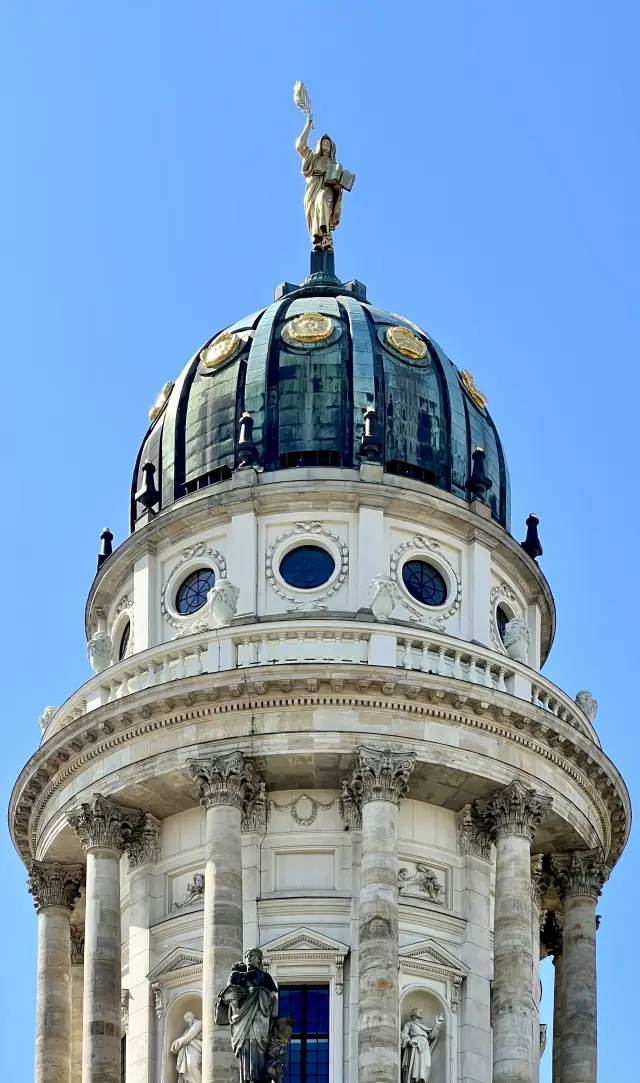
The figures that can be questioned in this way include the gilded dome figure of the French Cathedral (Französischer Dom), which Berlin calls “Nike”, the Schiller Monument with its four allegories, Saint George from the Nikolaiviertel, the Neptune Fountain, Victoria on the Brandenburg Gate and Goldelse on the Victory Column — precisely the figures whose history is told, with sources, on the preceding pages of this guide.
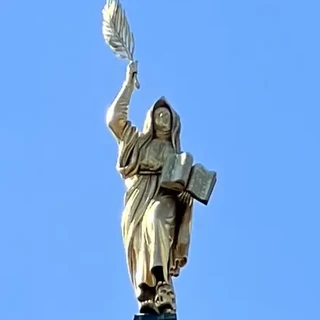 BerliNike (Nike)The golden figure on the dome of the French Cathedral at Gendarmenmarkt.Talk to the figure →
 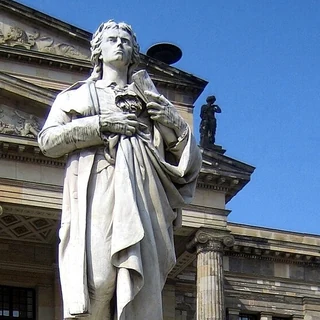 Friedrich SchillerThe Schiller Monument at Gendarmenmarkt, surrounded by four allegorical figures.Talk to the figure →
 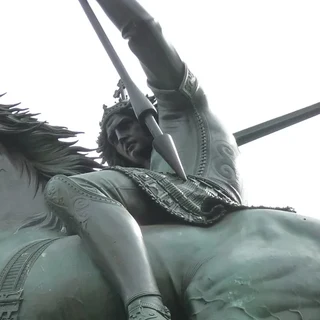 Saint GeorgeThe dragon slayer on the Spree bank in the Nikolaiviertel — back after decades away.Talk to the figure →
 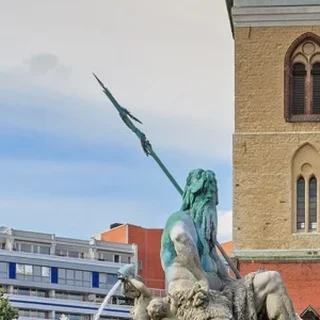 NeptuneThe Neptune Fountain between the Red City Hall, St Mary’s Church and the TV Tower.Talk to the figure →
 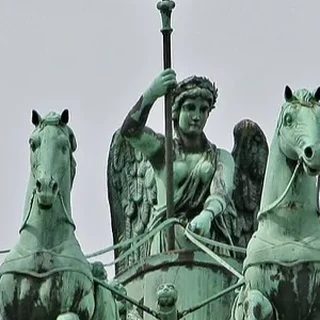 VictoriaThe goddess of victory on the Quadriga atop the Brandenburg Gate.Talk to the figure →
 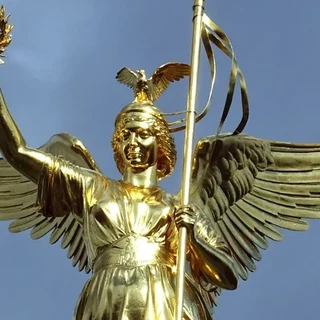 GoldelseThe gilded figure on the Victory Column in the Tiergarten, nicknamed after a novel.Talk to the figure →
An honest framework for an unusual offer
That a historical figure “speaks” is obviously a construction — nobody mistakes such a conversation for a real conversation with a historical person. The value lies elsewhere: the answers rest on researched facts about the figure in question and try to tell its history from a comprehensible, internally consistent perspective. For the statues, those are the records of the Berlin State Monument Office (Landesdenkmalamt) and the specialist literature; for Schiller as a person, his documented biography; for the mythological figures, the ancient tradition.23
With figures whose history contains difficult chapters — George’s exile, the destruction of the Quadriga in 1945, the relocation of the Victory Column by Albert Speer, the dismantling of the Schiller Monument in 1935 — the tone deliberately remains factual and restrained, not playfully trivialising. And if a quotation is attributed to a figure that it cannot reliably substantiate, it says so rather than inventing one.
How to try it out
Anyone wishing to visit one of the six figures will find, via the tiles on this page, direct access to its own page on berlinike.art — with further information and the possibility of asking a question of your own, by voice or by text, in the browser without an app. That works whether you are standing at the monument at that moment or exploring Berlin’s history from home.
- Before the visitRead the location page, skim the timeline, bring a question with you.
- At the monumentAsk the figure what no panel can answer: Why here? Why like this? What has it seen?
- AfterwardsCompare the answer with the sources at the end of the location page — the footnotes lead straight to the monument database.
- With othersIn groups, classes or families, consider together which question you would ask, and weigh the answer together.
What a conversation does not replace
However useful such an approach can be, it replaces neither the visit on site nor the reading of sound sources on the figure in question. Anyone wishing to engage with one of these monuments in a scholarly way will find far more depth in museums, archives and specialist literature than a short conversation can offer — the monument database of the Berlin State Monument Office, the Huguenot Museum in the French Cathedral, the Märkisches Museum with the surviving horse’s head of the Quadriga.4 The value of this offer lies in its low threshold: no museum visit and no booking are needed to get a first, accessible answer to a question that occurs to you in front of a monument.
A look back at this section
This section has approached Berlin’s history through three questions: what vanished and returned, what was built for a different city, and who still speaks to us today. All three questions lead to the same six figures — different angles on the same city, which visibly carries its history in stone, copper and bronze. Anyone wanting to go deeper will find the full history of each individual figure on the location pages of the guide, with measurements, dates and sources.
Frequently asked questions
Which figures can be questioned?
The dome figure of the French Cathedral, the Schiller Monument, Saint George, the Neptune Fountain, Victoria on the Brandenburg Gate and Goldelse on the Victory Column — the same six whose history this guide tells with sources.
Ask Nike yourself →Is it really a historical figure speaking?
Do you need an app?
No. The conversation runs in the browser, by voice or text, at the monument or from home.
Does the conversation replace the visit or the museum?
No. It is a low-threshold first approach. Anyone wanting to go deeper will find more in the monument database of the Berlin State Monument Office, in the Huguenot Museum or in the Märkisches Museum with the surviving horse’s head of the Quadriga.4
How is it best used?
Right at the monument, with a question no panel can answer: Why here? Why like this? What has the figure seen? Afterwards, the answer can be compared with the sources on the location pages.
Ask George yourself →