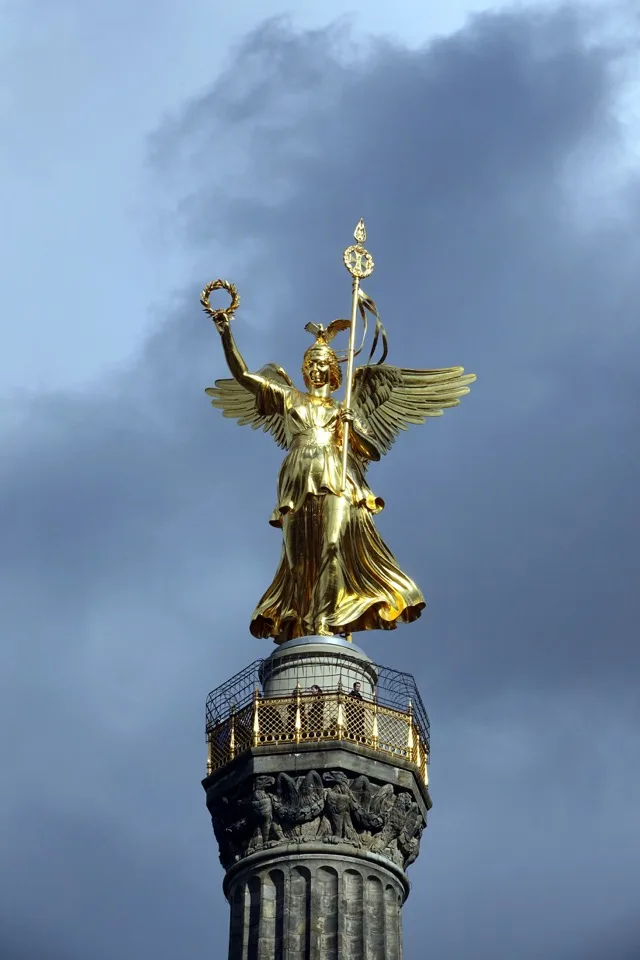
Monuments look as though they have always stood where you find them. In Berlin that is rarely true. The Victory Column stands on a square that was enlarged two and a half times to accommodate it. The Neptune Fountain stands on the axis of a TV Tower built eighty years after it. And the domed towers on Gendarmenmarkt, on which the “Nike” stands, were built by a king so that his square would look like one in Rome. This page tells how urban planning relocates monuments, raises them and places them in new contexts — and what remains of the original intention in the process.
The Victory Column: moved, raised, reinterpreted
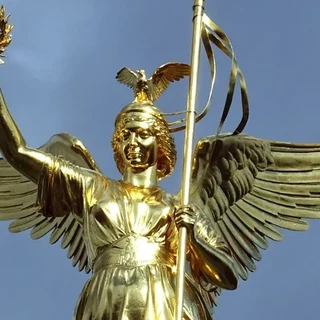
The Victory Column was built between 1865 and 1873 to a design by Heinrich Strack and stood until 1938 on Königsplatz, today’s Platz der Republik in front of the Reichstag. It was conceived as a victory monument for the Danish campaign of 1864; through the wars against Austria and France it became a monument to three wars, inaugurated on 2 September 1873.12 Friedrich Drake’s gilded Victoria, 8.32 metres tall, has crowned it ever since — with a victor’s wreath, a field standard and a Prussian eagle helmet, and thus at the same time as Borussia.12
In 1938 the relocation began. Königsplatz was to be turned into a vast parade ground according to plans by Albert Speer, the Inspector General of Buildings; the column moved to the Großer Stern, where it became the landmark, visible from afar, of the extended East–West Axis.1 To improve the urban effect, Speer had the base widened and the shaft raised by a fourth column drum — 60.5 metres became just under 67.12 The Großer Stern itself grew from 80 to 200 metres in diameter and received four gatehouses and pedestrian tunnels; along with the column, the monuments to Bismarck, Moltke and Roon moved here from Königsplatz.13
- 1864Design after the victory in the Danish campaign.
- 1873Inauguration on 2 September on Königsplatz; the column measures 60.5 metres.
- 1938On 27 July, dismantling begins on Königsplatz.
- 1939Re-erection at the Großer Stern with a fourth drum and a widened base; the square is enlarged from 80 to 200 metres in diameter.
- 1945The reliefs on the base are removed and taken to France.
- 1946On 26 November, France applies for the demolition of the column — without success.
- 1987The reliefs return and are reattached.
- 2010 – 2011Restoration and regilding of the Victoria.
The result is a figure that stands higher than its builders intended, in a place its builders did not know, on an axis that was meant to serve a dictatorship. The column largely survived the war; in 1946 France applied for its demolition, without success. The reliefs on its base, which narrate the wars of unification, were removed after 1945 and only came back in 1987.12 Anyone who climbs the 285 steps to the platform today stands on a structure whose reinterpretations are visible only to those who know — nobody notices the fourth drum unless they know it is there.2
The Neptune Fountain: placed on the axis of a tower
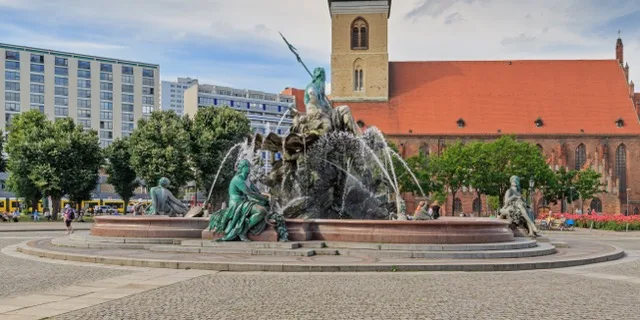
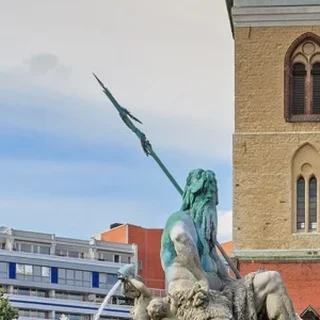
When Reinhold Begas designed his fountain between 1878 and 1885, he had no particular place in mind — it was a free creation without a commission.4 The City of Berlin then took over the financing and execution and presented the fountain to Kaiser Wilhelm II in 1888; in 1891 it was inaugurated on the southern Schlossplatz, on the axis of Breite Straße, in front of the Berlin Palace (Stadtschloss).4 There it was part of the Palace ensemble.
After the demolition of the Palace in 1951 that ensemble had vanished — and with it the reason for the location. When the fountain was re-erected in 1969, a new site and a new logic were chosen: the intersection of the axes of the TV Tower and the Red City Hall (Rotes Rathaus), in the green space on Spandauer Straße, to mark the completion of the TV Tower.4 A fountain of the German Empire became a component of the socialist redesign of Berlin’s centre. It stands there to this day — and is being restored in 2026.5
The domed towers: Rome on Gendarmenmarkt
The third story is not about relocation but about intention. In 1773 Friedrich II decided to give Gendarmenmarkt a representative design; between 1780 and 1785 he had the two domed towers built to plans by Carl von Gontard — as an attraction for the layout of the square.6 The towers were built without any real function and have no formal or proportional relationship to the churches they are named after; their model is the pair of identical domed churches on the Piazza del Popolo in Rome.6 After the collapse of the tower of the German Church in 1781, Georg Christian Unger took over the execution.6
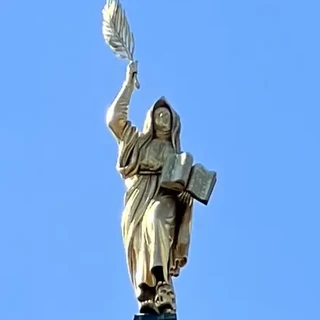
On the domes stand two allegorical figures, Virtue and Religion; the gilded figure on the French Cathedral (Französischer Dom), which Berlin calls “Nike”, is Religion Triumphant, 5.60 metres tall, after designs by Daniel Chodowiecki.67 So she stands on a tower that was built not for a congregation but for an image: a king who wanted his square to look like a Roman one. In 1944 the dome burned out; between 1981 and 1987 it was rebuilt and opened for the city’s 750th anniversary.7
What urban planning does to monuments
Three figures, three mechanisms. The Victory Column shows how a regime enlarges and moves an existing monument for its own ends. The Neptune Fountain shows how a city, having lost an ensemble, builds a monument into a new one. The domed towers show that even the creation of a landmark can follow a plan that has nothing to do with its later name. Anyone who visits all three sees the same lesson in three places: a monument is never just the figure. It is also the square, the axis and the intention of those who put it there.
Frequently asked questions
Why was the Victory Column moved in 1938/39?
Königsplatz was to become a vast parade ground according to plans by Albert Speer. The column went to the Großer Stern as the landmark of the East–West Axis; Speer had the base widened and the shaft raised by a fourth drum.13
Ask Goldelse yourself →How tall is the Victory Column today?
Why does the Neptune Fountain stand on the axis of the TV Tower?
Because its original site vanished with the Palace. For the re-erection in 1969, the intersection of the axes of the TV Tower and the Red City Hall was chosen, to mark the completion of the tower.4
Ask Neptune yourself →What were the domed towers on Gendarmenmarkt built for?
As ornamental towers without any real function, between 1780 and 1785 to plans by Carl von Gontard, so that Friedrich II’s square would look like the Piazza del Popolo in Rome. They have no structural relationship to the churches they are named after.6
When was the dome of the French Cathedral rebuilt?
It burned out in 1944 and was rebuilt between 1981 and 1987; the opening fell on 9 August 1987, during Berlin’s 750th anniversary celebrations.7
Ask Nike yourself →Sources and references
- Berlin State Monument Office (Landesdenkmalamt) — monument database, Großer Stern with Victory Column (object no. 09050419)
- Mitte district office, memorial plaque database — The Berlin Victory Column (PDF)
- Mitte district office, memorial plaque database — The relocation of the Victory Column 1938/39 (PDF)
- Berlin State Monument Office (Landesdenkmalamt) — monument database, Neptune Fountain (object no. 09011281)
- Mitte district office — press release no. 116/2026: Restoration of the Neptune Fountain
- Berlin State Monument Office (Landesdenkmalamt) — monument database, French Cathedral (object no. 09065017)
- Mitte district office, memorial plaque database — French Tower, chronology and technical data (PDF)