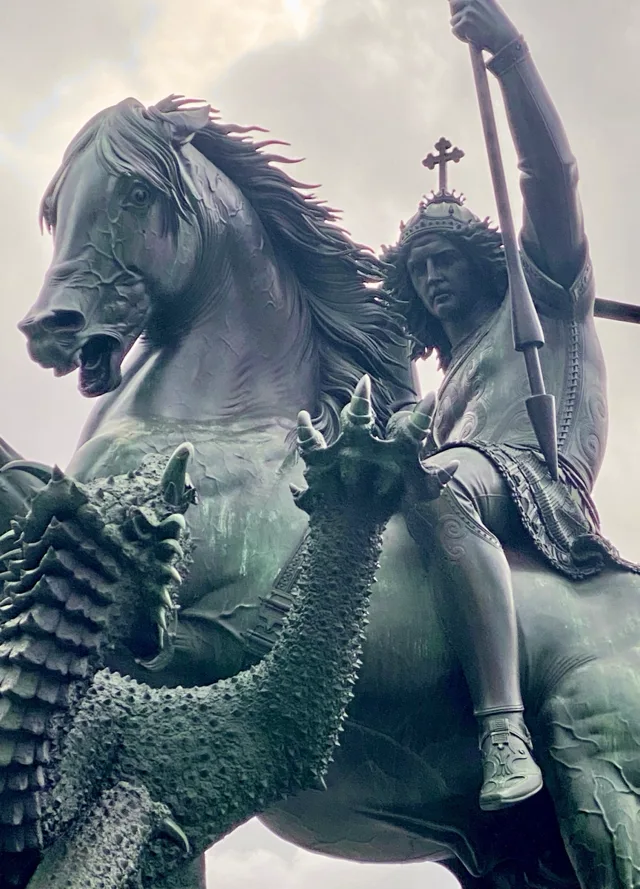
Four of Berlin’s best-known figures have one thing in common: there were years in which you would have looked for them in vain at their present location. A dragon-slayer stood in a public park, a sea god lay in crates, a goddess of victory was first war booty in Paris and later a heap of copper fragments, and a poet stood in Charlottenburg while his four companions were kept in storage in Friedrichsfelde. This page tells the four stories — with dates from the monument database of the Berlin State Monument Office (Landesdenkmalamt) and from the specialist literature.
Saint George: 37 years in the wrong place
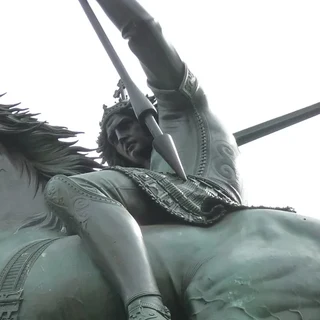
When August Kiß created his George between 1853 and 1855, the Berlin Palace (Stadtschloss) was the obvious place for such a figure. In 1865 the bronze arrived in the first courtyard of the Palace as a gift to King Wilhelm I and stayed there for 85 years.12 Then, in 1950, the GDR blew up the war-damaged Palace, and George had to make way — for Volkspark Friedrichshain, first by the rubble hill, then by the Großer Teich pond.12 A park with no connection to the figure: nobody had conceived the dragon-slayer for that spot; he stood there because there was room.
That lasted thirty-seven years. Only the reconstruction of the Nikolaiviertel for the city’s 750th anniversary in 1987 brought him back to the centre, at the wish of the architect Günter Stahn, on a plinth of reddish granite on the bank of the Spree, where today he marks the entrance to the quarter.23 A thorough restoration followed in 2010/11.1
The Neptune Fountain: 18 years in crates
The fountain by Reinhold Begas was inaugurated on 1 November 1891 on Schlossplatz and stood for sixty years in front of the portal of the Berlin Palace, on the axis of Breite Straße.4 With a basin eighteen metres across and a height of ten metres, it was one of the largest fountains of its day.4 When the Palace was pulled down in 1950/51, there was no longer any room for the fountain either: in 1951 it was dismantled and put into storage.4 As early as 1946, scrap-metal thieves had damaged the figures.5
Eighteen years lay between its removal and its re-erection. To mark the completion of the TV Tower, the fountain was restored between 1967 and 1969 and rebuilt in 1969 on the forecourt of the Red City Hall (Rotes Rathaus) — at a site it was never intended for, on the axis of a structure that did not exist when the fountain was made.45 The destroyed original basin of polished Swedish marble was replaced with red granite.5 In 2026 the fountain is being restored once more; the Mitte district office plans to complete the work by the end of the year.6
- 1806December: Napoleon has the Quadriga taken down and shipped to Paris in twelve crates.
- 1814Return after the Wars of Liberation; on 7 August it stands on the Gate again, now with the Iron Cross and eagle.
- 1935 – 1936The Schiller Monument is dismantled and badly damaged in the process.
- 1945The Quadriga is destroyed in the Battle of Berlin; one horse’s head survives.
- 1950 – 1951Demolition of the Palace: George goes to Volkspark Friedrichshain, the Neptune Fountain into storage.
- 1951The Schiller figure stands in Lietzenseepark (West); the allegories are stored in Tierpark Friedrichsfelde (East).
- 1957 – 1958Recreation of the Quadriga from the plaster cast of 1942; erected in 1958.
- 1969The Neptune Fountain stands again, in front of the Red City Hall.
- 1987George returns to the bank of the Spree.
- 1988The Schiller Monument stands in front of the Konzerthaus once more.
The Quadriga: plunder, return, destruction, recast
The goddess of victory on the Brandenburg Gate has suffered two losses — and on neither occasion did she come back under her own power. The first was a theft: after his entry into Berlin on 27 October 1806, Napoleon had the Quadriga taken down in December and shipped to Paris in twelve crates, where it arrived in May 1807.7 It stayed there for eight years. After the Wars of Liberation, Friedrich Wilhelm III brought it back; it was restored at the Grunewald hunting lodge and stood on top of the Gate again on 7 August 1814. Karl Friedrich Schinkel gave her a new emblem to hold: an oak wreath with the Iron Cross and a Prussian eagle.78
The second loss was final. In the Battle of Berlin in 1945 the Quadriga was largely destroyed; a single horse’s head survived, today in the Märkisches Museum.7 That it exists again is owed to a protective plaster cast taken in 1942. In 1956 the East Berlin Magistrat decided on the reconstruction; Otto Schnitzer took it on, and the casting was done at Hermann Noack in Friedenau — in West Berlin, on commission from East Berlin, one of the few collaborations across the sector boundary. On 14 December 1957 the group was finished; in 1958 it stood on the Gate again.7 The Iron Cross and the eagle were removed that same year and only returned in 1991/92.78
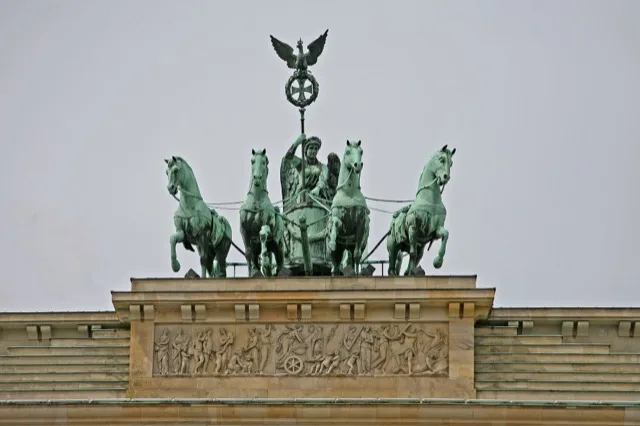
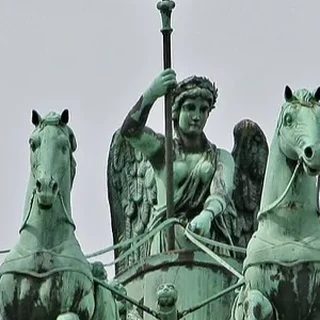 VictoriaThe goddess of victory on the Quadriga atop the Brandenburg Gate.Talk to the figure →
The Schiller Monument: a poet in two halves of the city
The monument by Reinhold Begas, unveiled on Gendarmenmarkt in 1871, was dismantled in 1935/36 for the redesign of the square — and toppled in the process, badly damaged.910 What happened next is the story of the divided city in miniature: in 1951 the marble figure of the poet went to Lietzenseepark in Charlottenburg, that is, to West Berlin; the four allegories — Lyric Poetry, Tragedy, History and Philosophy — were stored in Tierpark Friedrichsfelde in East Berlin.1011 One monument, two states.
Only the cultural agreement between the Federal Republic and the GDR of 6 May 1986 created the basis for bringing the parts back together. In December 1988 the monument stood in front of the Konzerthaus once more, as part of an exchange of cultural property; the stepped plinth was renewed.910 A thorough restoration followed in 2006, during which the lost dagger of Tragedy was also replaced.10
What links the four stories
None of these figures left of its own accord. War, the demolition of the Palace and the division of the city removed them from their places; reconstruction, anniversaries and a cultural agreement brought them back. That George now stands on the bank of the Spree rather than in the Palace courtyard, and Neptune in front of the City Hall rather than in front of the Palace, shows something else: in Berlin, a return rarely means a return to the same spot. The city they came back to was a different one from the city they had vanished from.
Frequently asked questions
How long did Saint George stand in Volkspark Friedrichshain?
37 years, from 1950/51 to 1987. After the Berlin Palace was blown up, the bronze went first to the rubble hill, then to the Großer Teich pond; with the reconstruction of the Nikolaiviertel it returned to the bank of the Spree.123
Ask George yourself →Where was the Neptune Fountain between 1951 and 1969?
In storage. Dismantled during the demolition of the Palace in 1951, it was restored between 1967 and 1969 and rebuilt in 1969 in front of the Red City Hall to mark the completion of the TV Tower.45
Ask Neptune yourself →How did the Quadriga get to Paris and back?
Napoleon had it taken down in December 1806 and shipped to Paris in twelve crates; after the Wars of Liberation, Friedrich Wilhelm III brought it back. On 7 August 1814 it stood on the Gate again, now with Schinkel’s Iron Cross and eagle.78
Ask Victoria yourself →Who recreated the Quadriga after 1945?
Working from a protective plaster cast of 1942, Otto Schnitzer reconstructed the group; it was cast at Hermann Noack in West Berlin, on commission from the East Berlin Magistrat. It was finished on 14 December 1957 and stood on top of the Gate again in 1958.7
Why was the Schiller Monument split between East and West?
After its dismantling in 1935/36, the marble figure went to Lietzenseepark in West Berlin in 1951, while the four allegories were stored in Tierpark Friedrichsfelde in East Berlin. Only the cultural agreement of 6 May 1986 brought the parts together; in December 1988 the monument stood in front of the Konzerthaus again.91011
Ask Schiller yourself →Sources and references
- Wikipedia (German) — Heiliger Georg (August Kiß)
- Bildhauerei in Berlin — Saint George as dragon-slayer
- Berlin State Monument Office (Landesdenkmalamt) — The Nikolaiviertel
- Berlin State Monument Office (Landesdenkmalamt) — monument database, Neptune Fountain (object no. 09011281)
- Wikipedia (German) — Neptunbrunnen (Berlin)
- Mitte district office — press release no. 116/2026: Restoration of the Neptune Fountain
- Wikipedia (German) — Brandenburger Tor
- Berlin State Monument Office (Landesdenkmalamt) — monument database, Brandenburg Gate (object no. 09065019)
- Berlin State Monument Office (Landesdenkmalamt) — monument database, Schiller Monument statue (object no. 09060093)
- Wikipedia (German) — Schiller-Denkmal (Berlin)
- Bildhauerei in Berlin — Schiller Monument