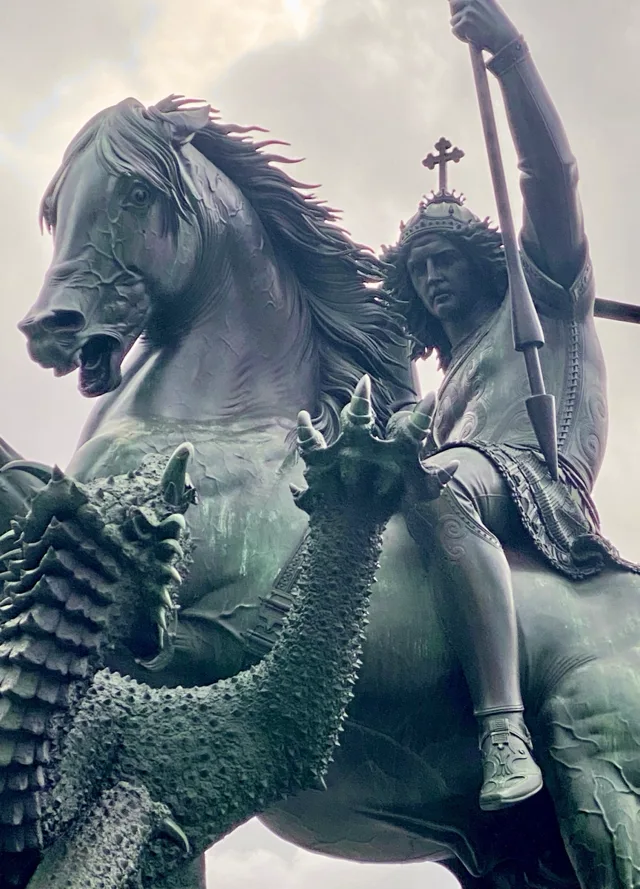
The Berlin George on the Spree belongs to a long line. Since the Middle Ages artists have painted the rider who defeats a dragon, and almost every century found its own picture of it. This page presents four paintings that shaped the motif and tells the legend they refer to. The history of the Berlin monument by August Kiß is in the guide to the Nikolaiviertel.
The legend: Silene and the king's daughter
The dragon episode is in the Golden Legend, the collection of saints' lives by Jacobus de Voragine from the 13th century. It tells of the city of Silene in Libya, whose people must feed a dragon from a nearby pond. At last the lot falls on the king's daughter. In William Caxton's English version: “the lot fell upon the king's daughter”.2 George appears, crosses himself, “garnished him with the sign of the cross”, and defeats the dragon.2
The link between George and the dragon is not old: the earliest evidence dates from the 11th century, among it frescoes at Göreme in Cappadocia and a Georgian text. The motif had earlier been attributed to Saint Theodore Tiro. In the 13th century the Golden Legend and the Speculum historiale made it known in the West.1
Raphael: the small picture, c. 1503–1505
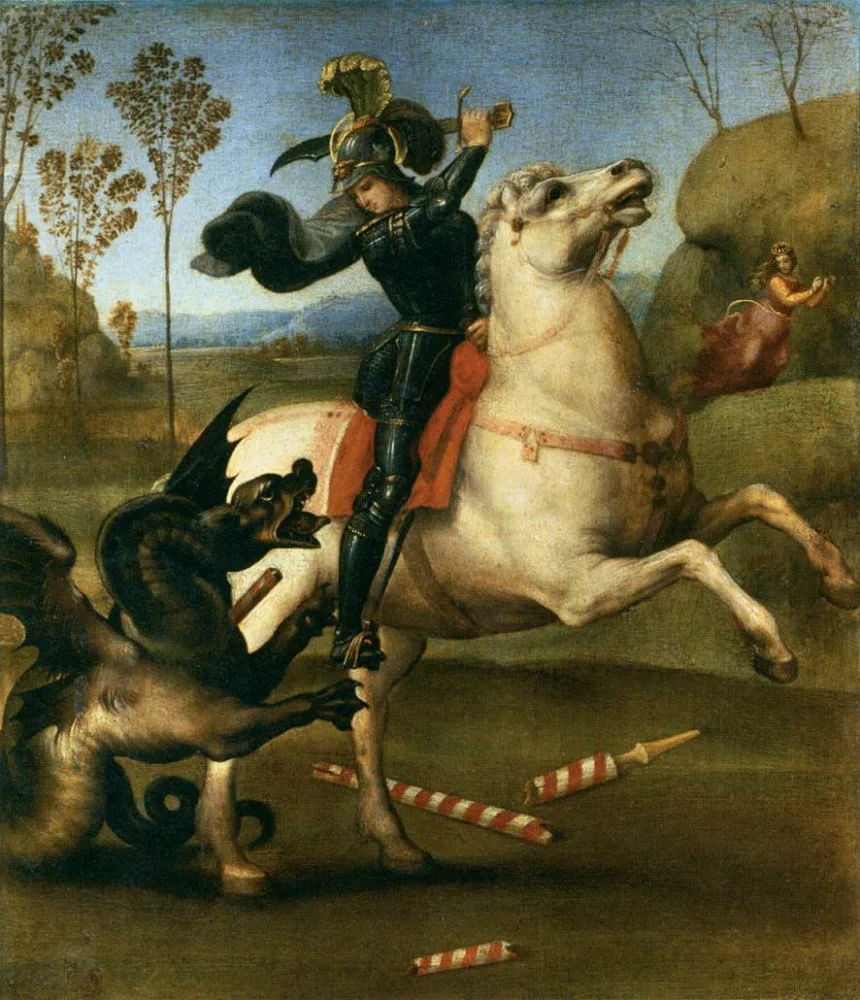
Raphael's George in the Louvre measures only 31 × 27 centimetres, a picture for the hand rather than the wall.3 The panel is an early work and still shows the influence of Perugino. On the patron, Giovanni Lomazzo reported in 1584: Guidobaldo da Montefeltro, Duke of Urbino. Wikipedia calls that account confused; what is certain is that the panel entered Cardinal Mazarin's collection and that Louis XIV acquired it from his heirs in 1661.3
Carpaccio: Venice, 1502
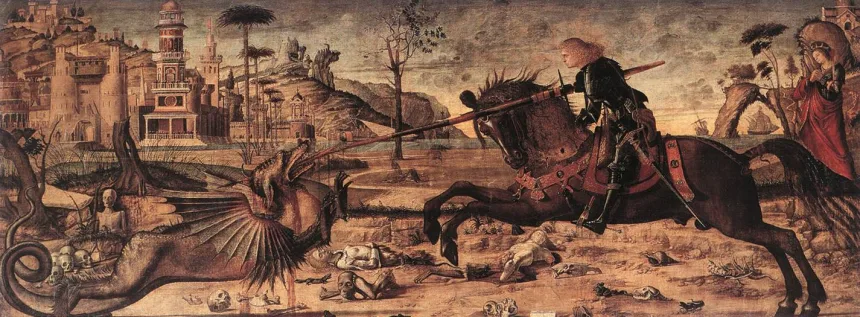
Vittore Carpaccio's George still hangs where it was painted for: in the Scuola di San Giorgio degli Schiavoni in Venice.4 The “Schiavoni” were Dalmatians who fought on the Venetian side against the Ottomans. The picture is the sixth in the Scuola's nine-part cycle and the first of three George paintings. In the background lies the invented city of Silene, with a bridge, Egyptian-looking gates and an obelisk; remains of the victims lie in the foreground.4
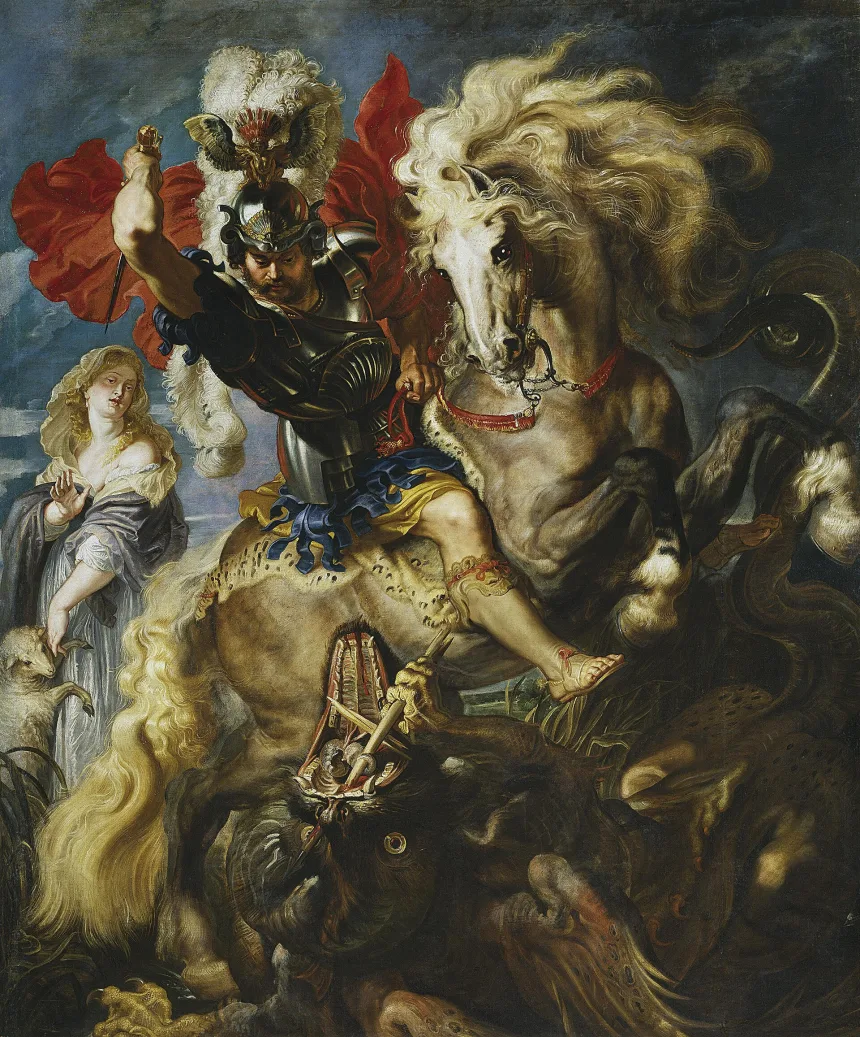
Rubens: Genoa, c. 1605–1607
Peter Paul Rubens painted his George in Italy. George is the patron saint of Genoa, and many scholars suspect the picture was meant for the church of Sant'Ambrogio, dedicated to him; this is not certain.5 Rubens kept the painting until his death in 1640; Philip IV of Spain acquired it afterwards. The princess is read as the Church, the lamb as Christ, and the serpent-like dragon points to the serpent in Paradise.5
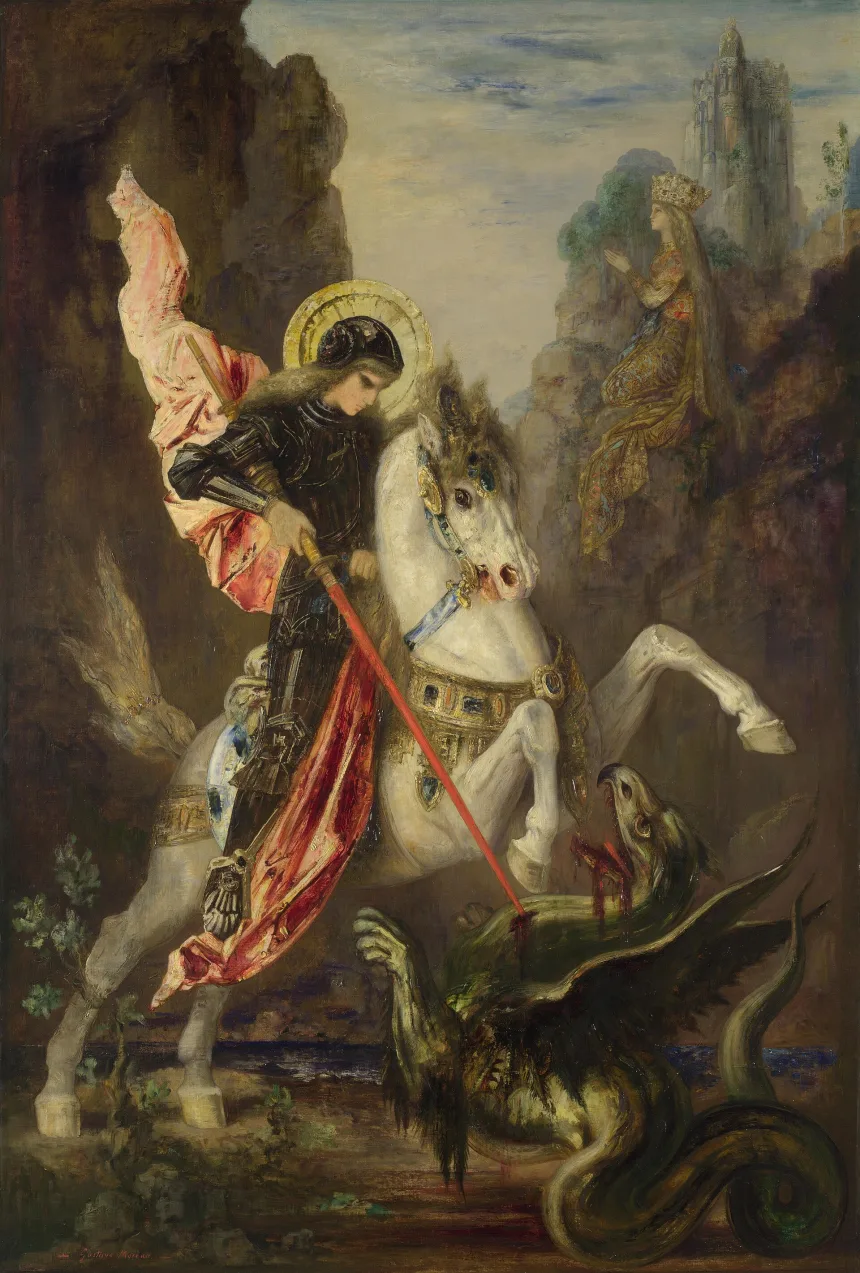
Moreau: Paris, 1889–1890
Gustave Moreau paints George as a slender youth with long flowing hair. The National Gallery lists the picture as NG6436 and names Raphael and Carpaccio as models, along with Byzantine icons and Indian and Persian miniatures.6 Moreau had copied Carpaccio as early as 1858; the copy hangs in the Musée Gustave Moreau.7
- 11th centuryFirst evidence of George as a dragon-slayer: frescoes at Göreme and a Georgian text.
- 1260s–1275Jacobus de Voragine tells the Silene legend in the Golden Legend.
- 1502Carpaccio's George for the Dalmatians' Scuola in Venice.
- c. 1503–1505Raphael's small George, now in the Louvre.
- c. 1605–1607Rubens paints the George now in the Prado.
- 1661Louis XIV acquires Raphael's George from Mazarin's heirs.
- 1858Moreau copies Carpaccio's George.
- 1889–1890Moreau completes his George, now in the National Gallery London.
Frequently asked questions
Which is the most famous George painting?
Where does the story of the dragon come from?
Why is there a George in Berlin too?
The Berlin George is a bronze by August Kiß, first shown at the Paris World Fair in 1855 and standing on the Spree in the Nikolaiviertel since 1987. The story is in the guide to the Nikolaiviertel.
Sources and references
- Wikipedia — Saint George and the Dragon (legend, earliest evidence, spread)
- Jacobus de Voragine — The Golden Legend, Life of St. George (Caxton, ed. F. S. Ellis; Fordham Medieval Sourcebook)
- Wikipedia — Saint George (Raphael, Louvre)
- Wikipedia — St. George and the Dragon (Carpaccio)
- Wikipedia — Saint George and the Dragon (Rubens)
- National Gallery London — Gustave Moreau, Saint George and the Dragon, 1889–90 (NG6436)
- Wikipedia — Gustave Moreau (copy after Carpaccio, 1858, Musée Gustave Moreau)