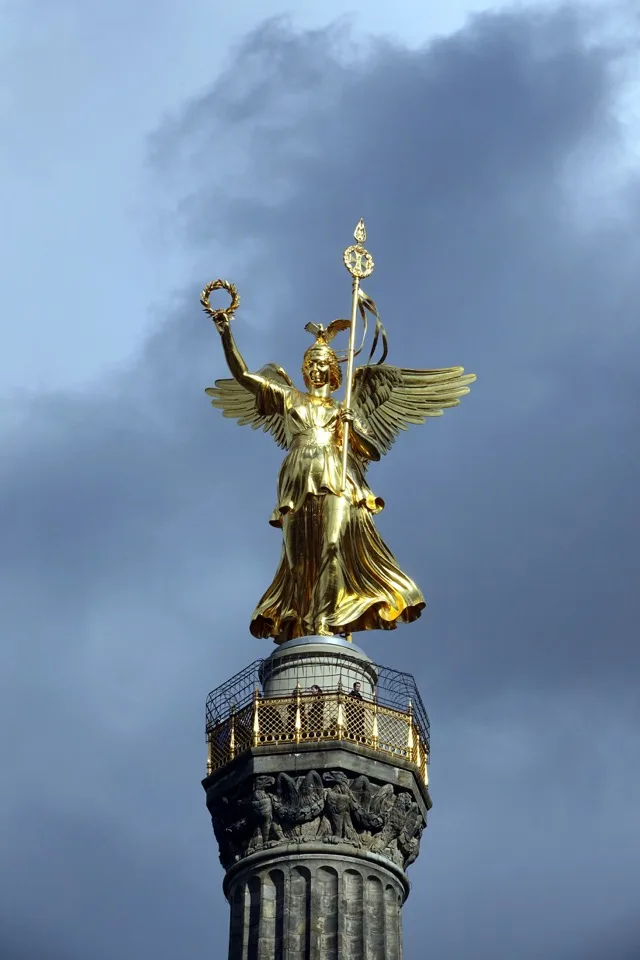
The gilded Victoria on Berlin's Victory Column, known in the vernacular as Goldelse, has two very different painters behind her: Anton von Werner, the history painter of the Empire, who worked for the column itself, and Lesser Ury, the Impressionist, who fifty years later painted the avenue to the column in autumn light. This page presents three of their pictures. The building history of the column is in the guide to the Brandenburg Gate and Tiergarten.
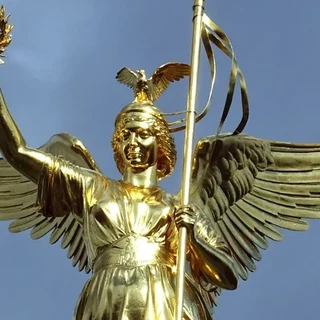
The goddess and her nickname
The bronze figure by Friedrich Drake is 8.32 metres high and weighs 35 tonnes.4 She owes her nickname “Goldelse” to the gilding and to E. Marlitt's novel “Goldelse”, which the magazine “Die Gartenlaube” serialised in 1866.4
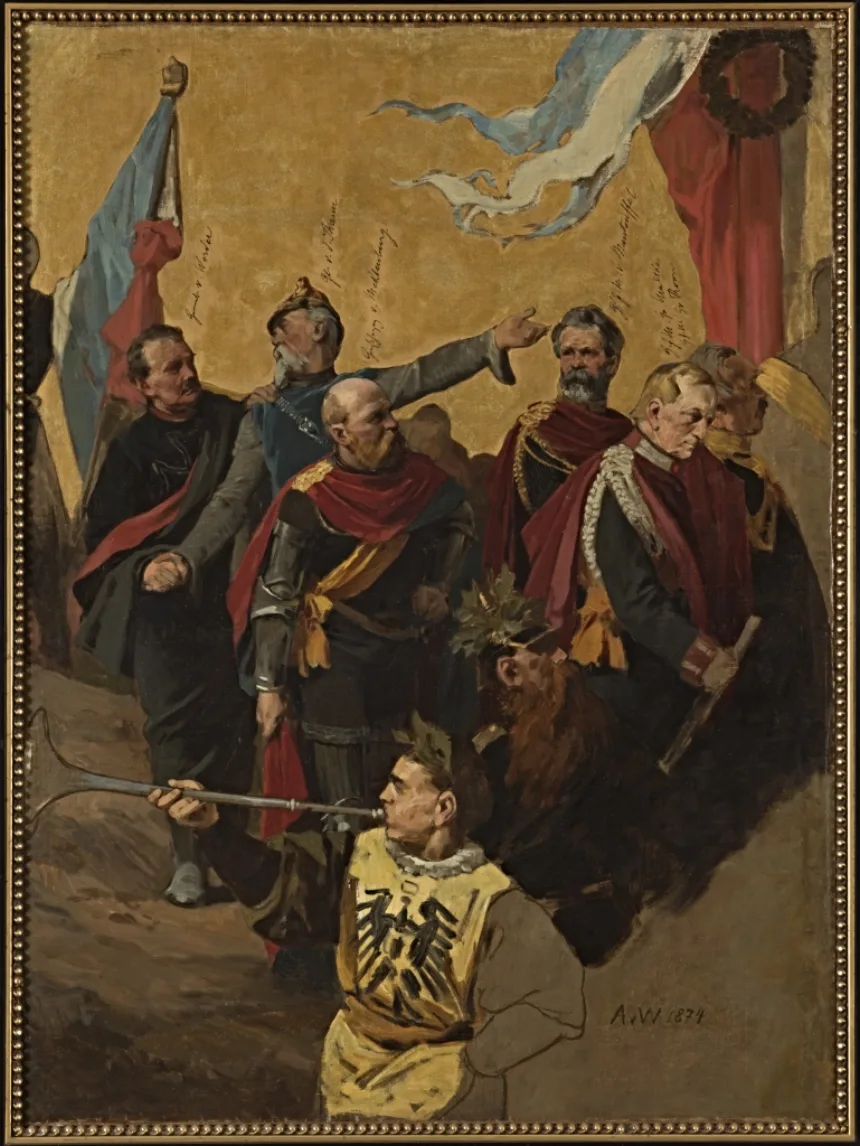
Anton von Werner: Struggle and Victory, 1874
Anton von Werner (1843–1915) was a painter and illustrator known for realistic depictions of the Franco-Prussian War and German unification.5 In 1873 he became a professor at the Berlin Academy, in 1875 its director.5 He created wall decorations for the Victory Column: the oil sketch “Struggle and Victory” of 1874 in the Berlinische Galerie is a design for a frieze of the column and measures 64 by 47.5 centimetres.15 The glass mosaic on the back wall of the column hall was made after a cartoon by him and produced in 1876 by the firm Antonio Salviati in Venice; at the inauguration only the cartoon was in place. It shows the founding of the German Empire as a consequence of the victory over France.4
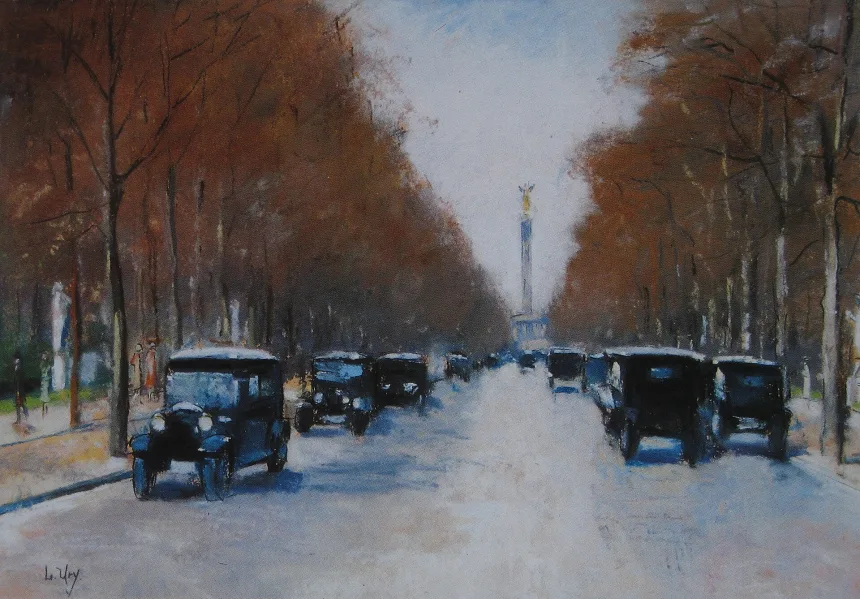
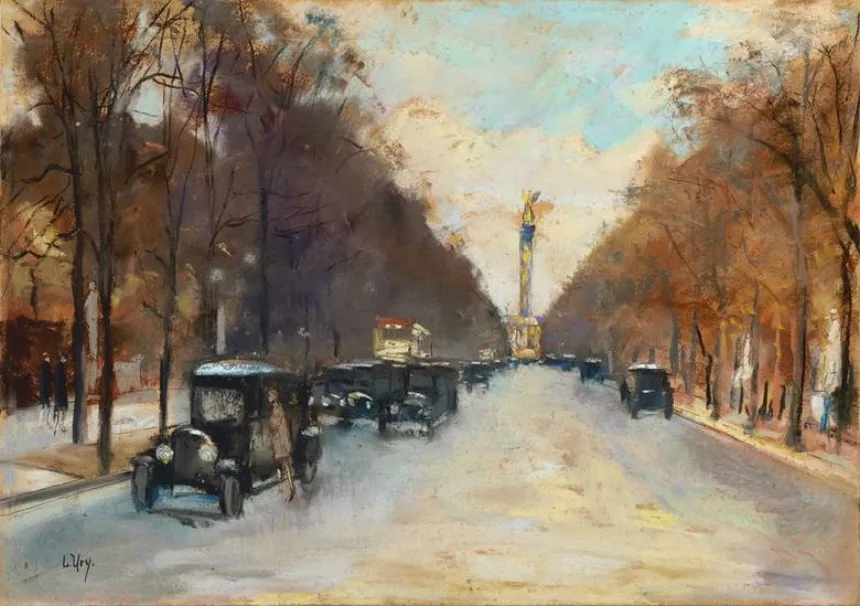
Lesser Ury: the avenue to the column, c. 1925
Lesser Ury (1861–1931) was born in Birnbaum in the province of Posen and moved with his family to Berlin after his father's death in 1872; from 1901 he exhibited with the Berlin Secession.6 He is regarded as an Impressionist; he is known for night cafés, rain-wet streets and the light of street lamps.6 His two pictures of the Victory Column show the avenue in the Tiergarten: “Tiergarten avenue with the Victory Column” of 1925 is signed “L. Ury” at the bottom;2 “Siegesallee with the Victory Column in autumn” of c. 1925 is a pastel on cardboard of 35 by 49.8 centimetres.3
- 1866E. Marlitt's novel “Goldelse” appears in “Die Gartenlaube”.
- 1873The Victory Column is inaugurated on 2 September; Anton von Werner becomes a professor at the Berlin Academy.
- 1874Von Werner paints the oil sketch “Struggle and Victory”.
- 1876The glass mosaic after von Werner's cartoon is made by Salviati in Venice.
- 1901Lesser Ury goes to Berlin again and exhibits with the Secession.
- 1925Ury paints “Tiergarten avenue with the Victory Column”.
Frequently asked questions
Why is the Victory Column's Victoria called Goldelse?
Because of the gilding and E. Marlitt's novel “Goldelse”, which appeared in “Die Gartenlaube” in 1866.4
Who made the mosaic at the Victory Column?
It was made after a cartoon by Anton von Werner and produced in 1876 by the firm Antonio Salviati in Venice.4
Where does von Werner's oil sketch hang?
In the Berlinische Galerie, inventory number BG-M 0184/76.1
Sources and references
- Wikimedia Commons — Anton von Werner, Kampf und Sieg (oil sketch for the frieze of the Victory Column), Berlinische Galerie
- Wikimedia Commons — Lesser Ury, Tiergartenallee mit Siegessäule (1925)
- Wikimedia Commons — Lesser Ury, Siegesallee mit Siegessäule im Herbst (c. 1925)
- Wikipedia — Berliner Siegessäule (German)
- Wikipedia — Anton von Werner
- Wikipedia — Lesser Ury
_-_BG-M_0184%5E76_-_Berlinische_Galerie.jpg)

