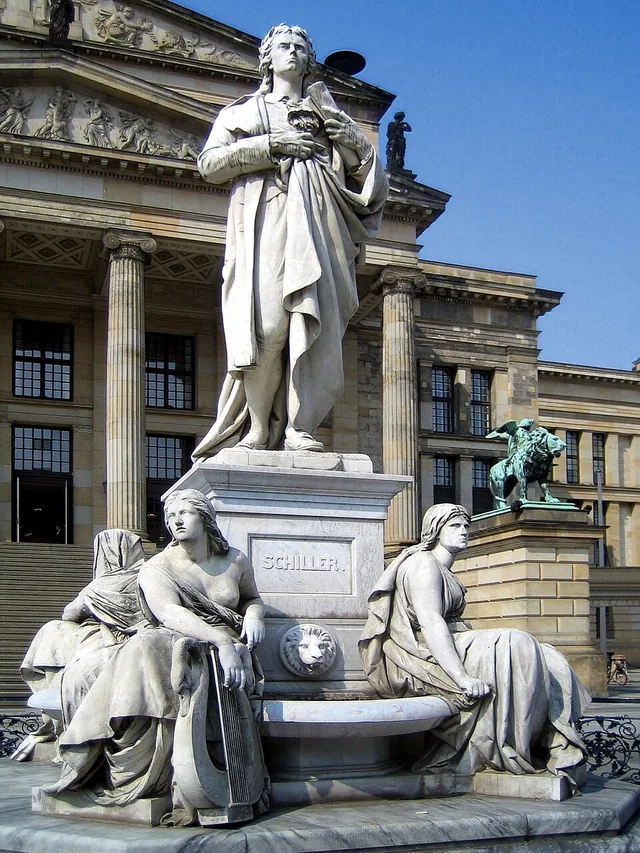
What did Friedrich Schiller look like? Whoever pictures him usually sees a face that a painter recorded between 1786 and 1791. This page presents three portraits that shaped Schiller's image and describes how they came about. The Berlin Schiller Monument by Reinhold Begas stands on the Gendarmenmarkt; its story is told in the guide to the Gendarmenmarkt.
The poet
Schiller was born on 10 November 1759 in Marbach and died on 9 May 1805 in Weimar.1 His first drama The Robbers appeared in 1781; the 1785 poem “Ode to Joy” became the basis of the fourth movement of Beethoven's Ninth Symphony.1 In 1871 Berlin unveiled his monument on the Gendarmenmarkt.1
Anton Graff: the famous portrait, 1786–1791
Anton Graff's portrait is the picture one associates with Schiller today: the poet at a table, his head resting on his hand. The painting measures 71 × 57 centimetres.3 Graff began it in spring 1786 and finished it only in September 1791.2 The Gleimhaus museum in Halberstadt, which documents the origin of the first engraving, reports that Graff complained of Schiller's restlessness during the sittings until the elegiac pose was found that made the portrait famous. The work remained unfinished for some years. In 1791 Graff completed it without Schiller sitting again; it then went to the Nuremberg publisher Johann Friedrich Frauenholz, who issued a copper engraving after it, one of the earliest printed portraits of Schiller.2 The engraving by Johann Gotthard Müller bears the date 1793.2
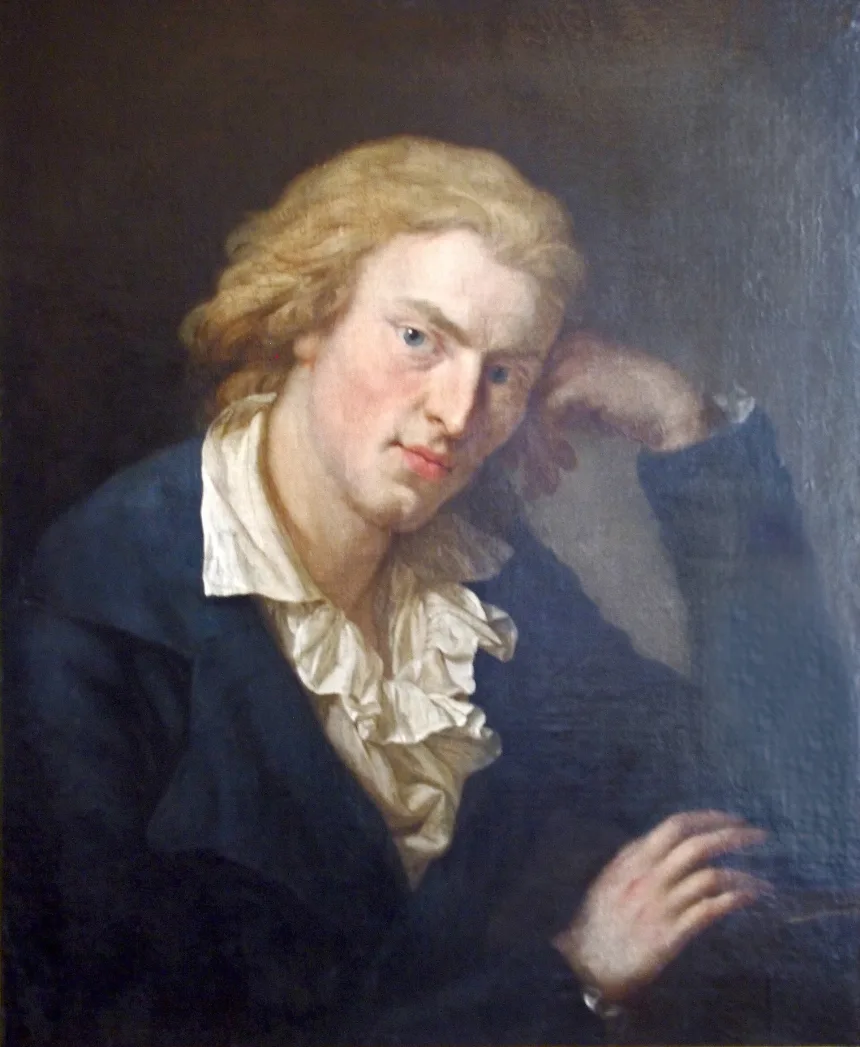
Ludovike Simanowiz: the friend's portrait, 1793/94
Ludovike Simanowiz, born in Schorndorf in 1759, grew up in Ludwigsburg together with Schiller and his sisters.5 She painted him and his wife Charlotte while Schiller was working on Wallenstein at home.5 Commons dates the picture to 1793 to 1794 and gives no location; the painting's dimensions are not recorded there.4
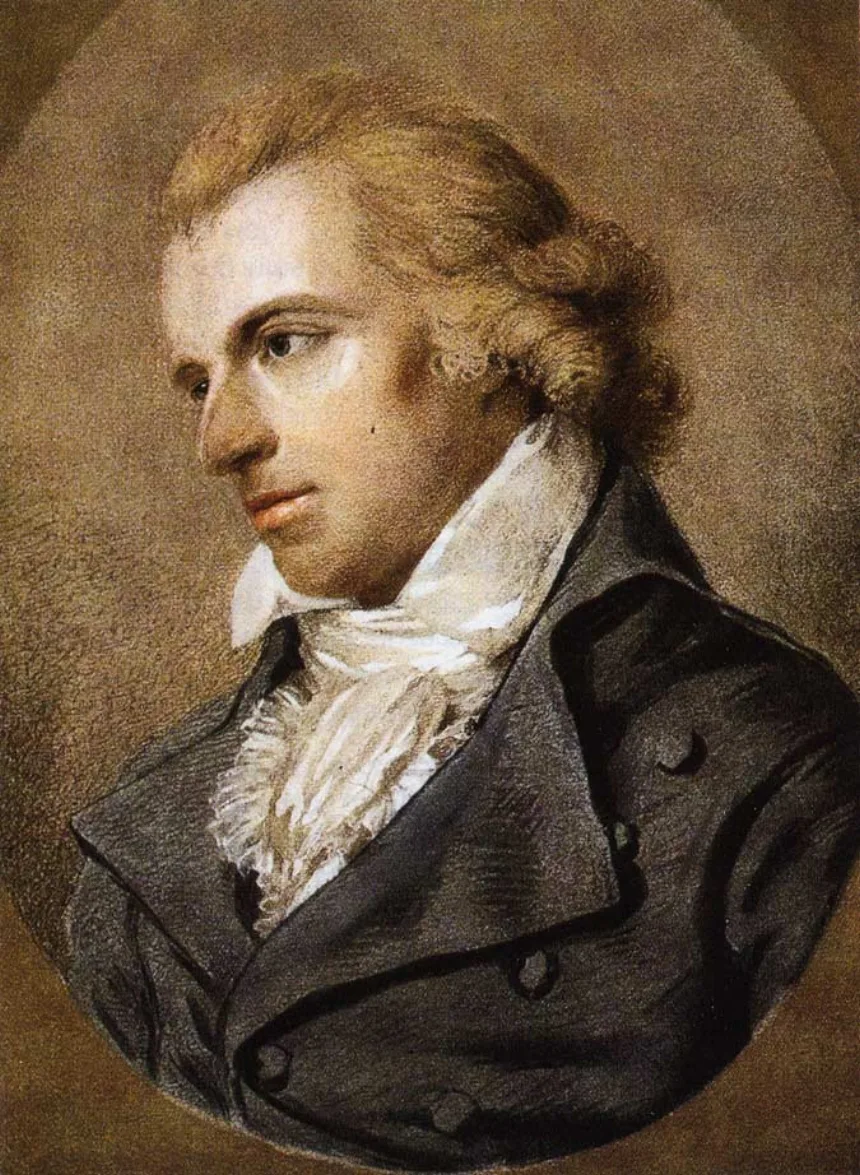
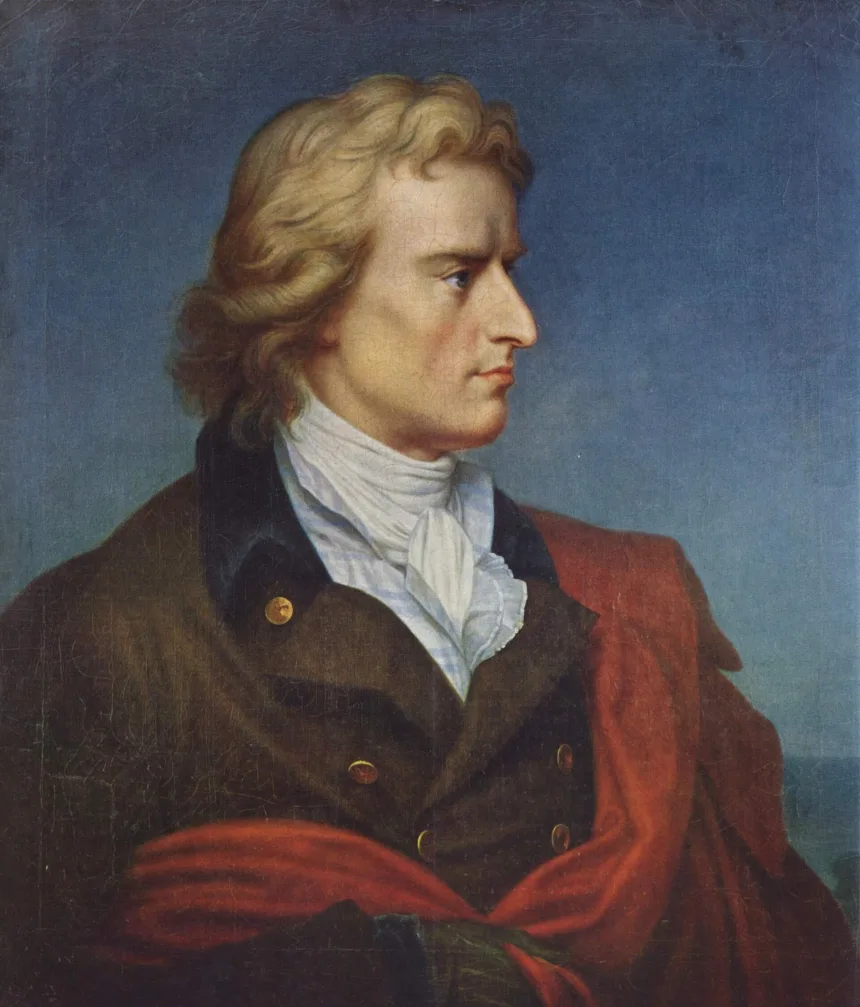
Gerhard von Kügelgen: the memorial portrait, 1808/09
Gerhard von Kügelgen's picture was made three to four years after Schiller's death. Commons lists it with the date 1808 to 1809 and the location Frankfurt Goethe Museum; it measures 73 × 61 centimetres.6 Unlike with Graff and Simanowiz, the poet did not sit for it.
- 1759Friedrich Schiller is born in Marbach on 10 November.
- 1781“The Robbers” is published.
- 1786Anton Graff begins the portrait of Schiller.
- 1791Graff completes the portrait without Schiller sitting again; Frauenholz acquires it.
- 1793Johann Gotthard Müller dates his copper engraving after Graff's picture.
- 1793–1794Ludovike Simanowiz paints Schiller.
- 1805Schiller dies in Weimar on 9 May.
- 1808–1809Gerhard von Kügelgen paints Schiller after his death.
- 1871The Schiller Monument is unveiled on the Gendarmenmarkt in Berlin.
Frequently asked questions
Which portrait shows Schiller most reliably?
Where does Graff's portrait of Schiller hang?
The Städtische Galerie Dresden holds it; Commons gives the Kügelgenhaus, Museum of Dresden Romanticism, as its current location.3
Who made the Schiller Monument in Berlin?
Reinhold Begas; the monument's story is in the guide to the Gendarmenmarkt.
Sources and references
- Wikipedia — Friedrich Schiller
- museum-digital Sachsen-Anhalt (Museum Gleimhaus Halberstadt) — Portrait of Friedrich Schiller, copper engraving by J. G. Müller after Anton Graff, 1793
- Wikimedia Commons — Anton Graff, Portrait of Friedrich Schiller (Städtische Galerie Dresden)
- Wikimedia Commons — Ludovike Simanowiz, Friedrich Schiller
- Wikipedia — Ludovike Simanowiz
- Wikimedia Commons — Gerhard von Kügelgen, Friedrich Schiller (Goethe House, Frankfurt)
.jpg)

