Between the Spree, the Red City Hall (Rotes Rathaus) and the TV Tower lies the oldest part of Berlin — and at the same time one of the youngest: the Nikolaiviertel was rebuilt between 1979 and 1987 in the manner of its historical appearance, after the war had destroyed it almost completely.1 Two large bronzes belong to this part of the city: Saint George fighting the dragon on the bank of the Spree, and the Neptune Fountain in the green space in front of the City Hall. Both once stood at the Berlin Palace (Stadtschloss). Both had to go when the Palace was blown up. And both came back — only to places other than those they had been made for.
The quarter: old and new at once
The narrow, irregular lanes around the Nikolaikirche, a church whose origins go back to the founding of Berlin, give the impression of a medieval street plan.1 What looks so complete today is the result of a reconstruction for the city’s 750th anniversary in 1987: under the architect Günter Stahn, an ensemble of reconstructed and newly built houses arose around the church on roughly five hectares.2 The Nikolaikirche itself was completed around 1230 and enlarged into a Gothic hall church around 1264.2
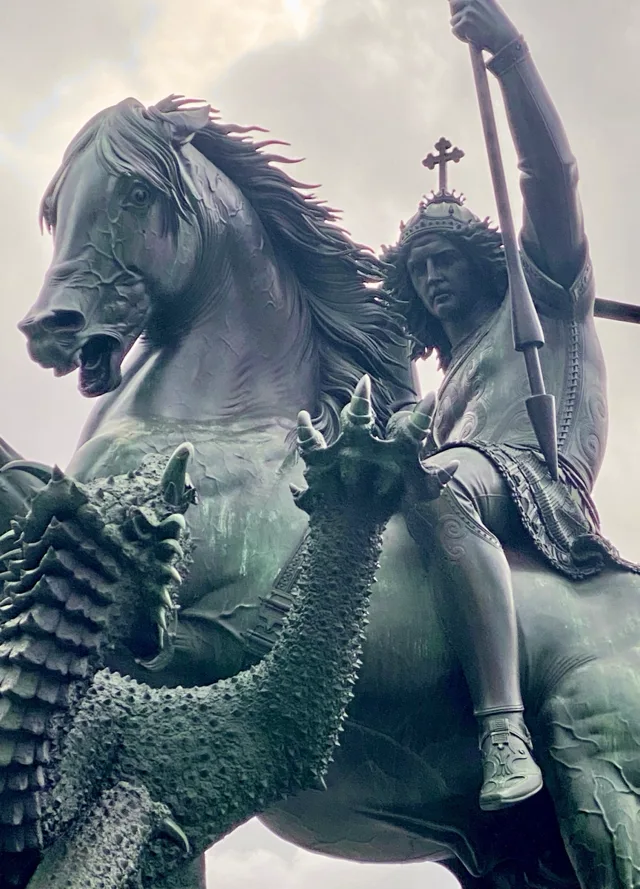
At the approach from the bank of the Spree, Saint George marks the entrance to this quarter.1 He is the only equestrian statue here — and a figure that for a long time had nothing at all to do with the Nikolaiviertel.
Saint George: a dragon slayer on his travels
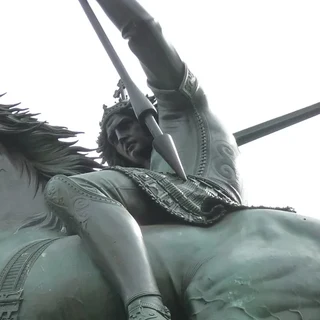
The bronze equestrian statue is by August Kiß (1802 – 1865), an important representative of the Berlin school of sculpture, and ranks among his principal works.1 George wears a helmet with a cross, draws back his sword to strike and at the same time holds the cross staff with its banner; the dragon beneath him presses a claw into the horse’s chest. Kiß had earlier modelled an Archangel Michael as a dragon slayer — the subject occupied him for some time.3
The figure was begun in 1853 and is signed “KISS / BERLIN 1855”. A plaster model travelled in a specially built railway wagon to the World’s Fair in Paris, where it won second prize in 1855.3 In 1865 the finished bronze was given to King Wilhelm I and set up in the first courtyard of the Berlin Palace, the Eosanderhof. The sources differ on who made the gift: the sculptor’s widow or the city, to which Kiß had bequeathed the figure.34 George stood there for 85 years.
- 1853 – 1855August Kiß creates the figure; the plaster model wins second prize at the Paris World’s Fair in 1855.
- 1865The bronze arrives as a gift to King Wilhelm I in the first courtyard of the Palace.
- 1950 – 1951The war-damaged Palace is blown up; George moves to Volkspark Friedrichshain, finally to the Großer Teich pond.
- 1987With the reconstruction of the Nikolaiviertel the figure returns to the city centre, to the bank of the Spree.
- 2010 – 2011Restoration in Adlershof for around 120,000 euros; rededication on 24 June 2011.
In 1950 the war-damaged Palace was blown up, and George had to make way. He spent the following decades in Volkspark Friedrichshain — first at the rubble hill, then at the Großer Teich pond: a site with no connection to the figure, an exile, not a place of honour.34 Only in 1987, at the request of the Nikolaiviertel architect Günter Stahn, did he return to the centre of the city, on a plinth of reddish granite on the bank of the Spree.4 In 2010 and 2011 the bronze was comprehensively restored in Adlershof and rededicated on 24 June 2011.3
The Neptune Fountain: a gift nobody had ordered
Reinhold Begas’s Neptune Fountain has stood since 1969 where the axes of the TV Tower and the Red City Hall meet, in the green space on Spandauer Straße. It was executed between 1888 and 1891 and stood from 1891 to 1951 on the southern Schlossplatz, on the axis of Breite Straße.5 With a basin eighteen metres in diameter and a total height of ten metres, it was in its day among the largest sculptural fountains in the world.5
Begas designed the fountain between 1878 and 1885 without a commission at first, as a free creation. Only afterwards did the City of Berlin take over its financing and execution, and in 1888 made it a gift to Kaiser Wilhelm II.5 The bronze casting was carried out between 1888 and 1890 by Hermann Gladenbeck in Friedrichshagen; the inauguration took place on 1 November 1891.5
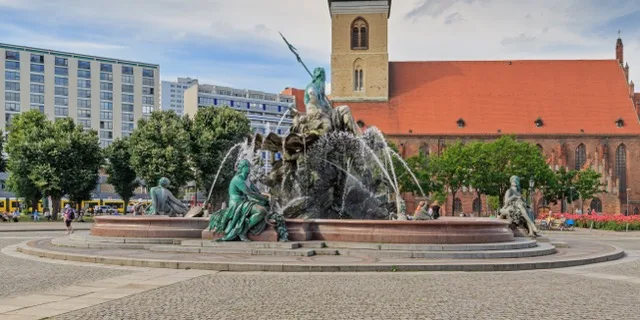
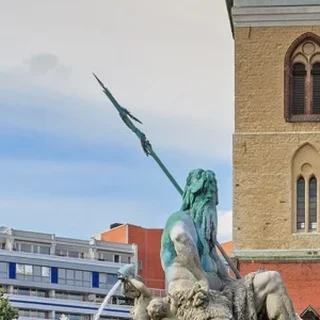
Neptune sits on a huge shell, borne by four tritons and surrounded by water-spouting putti and aquatic creatures; the composition recalls Bernini’s fountains in Rome.5 On the rim of the basin sit four female figures as personifications of the rivers Elbe, Rhine, Oder and Vistula — recognisable by their attributes: fishing net and grapes for the Rhine, ears of corn and fruit for the Elbe, goat and pelt for the Oder, logs of wood for the Vistula.56 Berliners soon nicknamed the fountain “Forckenbecken”, after the then mayor Max von Forckenbeck.6
- 1878 – 1885Begas designs the fountain without a commission.
- 1888The city takes over financing and execution and presents the fountain to Kaiser Wilhelm II; Gladenbeck begins the casting.
- 1891Inauguration on 1 November on the Schlossplatz.
- 1946Scrap-metal thieves damage the figures.
- 1951Dismantled and put into storage in the course of the Palace’s demolition.
- 1967 – 1969Restoration by Hans Füssel and the Lauchhammer foundry; re-erected in front of the Red City Hall to mark the completion of the TV Tower.
- 2026Restoration since May: basin, sealing and technical systems are being renewed, figures and rocks restored; around 1.2 million euros, completion planned by the end of 2026.
In 1951 the fountain was dismantled and put into storage in the course of the Palace’s demolition; eighteen years lay between its removal and its re-erection. To mark the completion of the TV Tower, it was rebuilt in 1969 on the square in front of the City Hall, after a restoration by Hans Füssel and the Lauchhammer foundry.56 The original basin of polished red Swedish marble had been destroyed; it was replaced with red granite.6
What you can see on site — and what you currently cannot
George stands freely accessible on the bank of the Spree, best viewed from the path along the water; from the opposite side near the Rathausbrücke you see him with the quarter in the background. For the Neptune Fountain, 2026 is a special case: it is covered in scaffolding.
Getting there and moving on
The Nikolaiviertel lies between the Spree and the Red City Hall. The nearest stations are Alexanderplatz (S-Bahn, U2, U5, U8) and Rotes Rathaus (U5), each a few minutes’ walk away. From the Gendarmenmarkt you reach the quarter on foot in about twenty minutes via the Schlossbrücke and the Museum Island. If you are following the order of this guide, take the S-Bahn from here on to the Brandenburg Gate.
History you can listen to
Both figures tell of their wandering years on berlinike.art in a voice of their own — George of the decades in the Volkspark, Neptune of the Schlossplatz, of the depot and of the scaffolding that currently surrounds him. A complement to the visit on site, not a substitute for it.
Frequently asked questions
Where did Saint George stand before he came to the Nikolaiviertel?
From 1865 to 1950 in the first courtyard of the Berlin Palace, and after its demolition until 1987 in Volkspark Friedrichshain — first at the rubble hill, then at the Großer Teich pond.34
Ask George yourself →Who created Saint George?
Why does the Neptune Fountain stand in front of the Red City Hall and not at the Palace?
It was inaugurated on the Schlossplatz in 1891, dismantled and put into storage in 1951 when the Palace was demolished, and re-erected in 1969 in the green space on Spandauer Straße to mark the completion of the TV Tower.56
Ask Neptune yourself →Which rivers do the four female figures on the Neptune Fountain represent?
Can the Neptune Fountain be seen in 2026?
Only behind scaffolding. The Mitte district office has been restoring it since May 2026 for around 1.2 million euros: the basin and sealing are being renewed, new technical systems installed, figures and rocks restored. Completion is planned by the end of 2026.7
Sources and references
- Berlin State Monument Office (Landesdenkmalamt) — The Nikolaiviertel
- Wikipedia (German) — Nikolaiviertel
- Wikipedia (German) — Heiliger Georg (August Kiß)
- Bildhauerei in Berlin — Saint George as dragon slayer
- Berlin State Monument Office (Landesdenkmalamt) — monument database, Neptune Fountain (object no. 09011281)
- Wikipedia (German) — Neptunbrunnen (Berlin)
- Mitte district office — press release no. 116/2026 of 8 May 2026: restoration of the Neptune Fountain