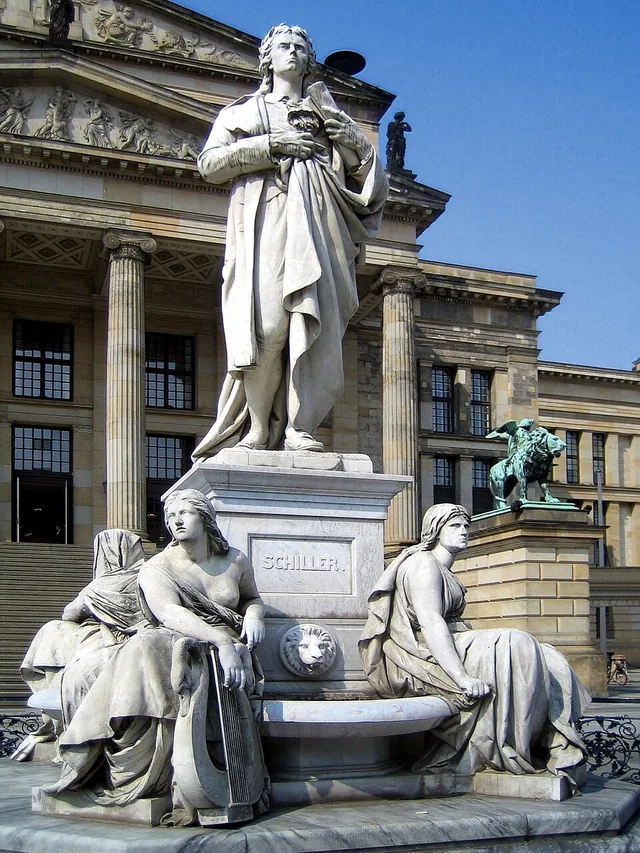
Many consider the Gendarmenmarkt the most beautiful square in Berlin: the German Cathedral and the French Cathedral (Französischer Dom) face each other, with Karl Friedrich Schinkel’s Konzerthaus between them. Those who look closely find two figures here that at first sight have little to do with each other, but at second glance both tell of victory, recognition and return: the poet Friedrich Schiller in the middle of the square and the gilded figure high up on the dome of the French Cathedral, which Berlin has called “Nike” for generations.
How the square came about
The two churches were the first buildings on the Mittelmarkt of the Friedrichstadt. The French Cathedral is older than its tower: begun in 1701 to plans by Louis Gayard, completed after his death by Abraham Quesnay and consecrated in 1705 as the parish church for the Huguenots settled in the Friedrichstadt.1 In 1773 Frederick II decided to give the square a prestigious design; only after the Gens d’armes regiment had been moved to the Dorotheenstadt in 1774 could the stables, barracks and guardhouse be demolished.2 In 1774 the square’s first theatre building went up between the churches, and in 1775 the enclosure of the square began with twenty three-storey houses to designs by Unger.2
The two domed towers were added between 1780 and 1785 — as an attraction for the design of the square, without any real function and without any formal relationship to the churches after which they are named. Their model is the pair of identical domed churches on the Piazza del Popolo in Rome. After the collapse of the tower of the German Church in 1781, Georg Christian Unger took over the execution.1 Schinkel built the Schauspielhaus in the middle between 1818 and 1821 on the foundation walls of the National Theatre, which had burnt down in 1817, aligned axially on the two domed towers; after severe war damage it was rebuilt as the Konzerthaus between 1976 and 1984.3
The Schiller Monument by Reinhold Begas
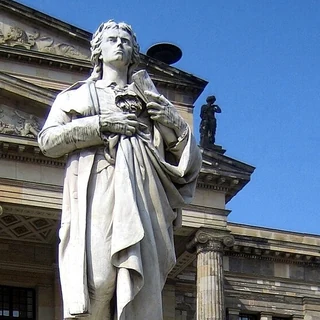
The foundation stone was laid on 10 November 1859, on the poet’s 100th birthday. In 1861 the Berlin city council (Magistrat) announced a competition; only at the beginning of 1864 did Reinhold Begas prevail over his rival Rudolf Siemering. The monument database dates the execution to 1864 to 1869; the signature bears the year 1869, the material is white Carrara marble, and the statue measures 2.95 metres.47 The monument was not unveiled until 10 November 1871 — the Franco-Prussian War had postponed the planned date.6
The monument is more than a figure on a plinth. On the rim of a basin sit four female allegories; in their midst a cube-like pedestal carries the poet, its sides decorated with lions’ heads, reliefs and inscriptions. The four allegories: at the front left Lyric Poetry, playing the harp; at the front right Tragedy, originally with a dagger and a mask at her feet; at the back History, writing Lessing, Kant and Goethe on a tablet, and Philosophy with a scroll bearing the Delphic “Know thyself”.6 The reliefs on the pedestal show Schiller receiving a lyre from the Muses and being presented to the poets of earlier times. The head, adorned with a laurel wreath, shows Schiller as a self-assured young poet.4
- 1759Friedrich Schiller is born in Marbach am Neckar; he dies in Weimar in 1805.
- 1859Laying of the foundation stone on the Gendarmenmarkt on 10 November, on his 100th birthday.
- 1861The city council announces the competition.
- 1864Reinhold Begas prevails over Rudolf Siemering; execution begins.
- 1869The monument is completed and signed; the unveiling follows on 10 November 1871.
- 1935 – 1936Dismantled in connection with the redesign of the Gendarmenmarkt; in the process the monument falls and is badly damaged.
- 1951The marble figure goes to the Lietzenseepark in Charlottenburg (West Berlin); the four allegories are stored in the Tierpark Friedrichsfelde (East Berlin).
- 1986The cultural agreement between the two German states of 6 May creates the basis for bringing the parts back together.
- 1988Return as part of an exchange of cultural property; re-erection in front of the Konzerthaus in December, the stepped base is renewed.
- 2006Comprehensive restoration; Tragedy’s lost dagger is replaced.
Dismantled in 1935, back after more than fifty years
The monument had to leave the square it was built for for half a century. In 1935 it was dismantled in connection with the redesign of the Gendarmenmarkt. The Schiller figure stood in the Lietzenseepark until 1987; the allegories were in interim storage.4 The division of the city divided the monument too: from 1951 the marble figure stood in the Lietzenseepark in West Berlin, while the four allegories were stored in the Tierpark Friedrichsfelde in East Berlin.67 Only the cultural agreement between the Federal Republic and the GDR of May 1986 made it possible to bring the parts back together; in December 1988 the monument stood in front of the Konzerthaus again, as part of an exchange of cultural property. On re-erection the stepped base was renewed; the basin’s function as a fountain did not return.46 A comprehensive restoration followed in 2006, during which Tragedy’s lost dagger was also replaced.6
The golden figure on the French Cathedral
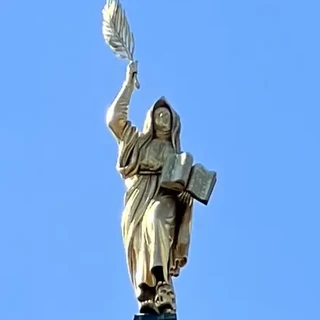
Far less often noticed than the Schiller Monument is the square’s second figure: the gilded form on the dome of the French Cathedral, with a raised palm frond. Berlin has called her Nike for generations, after the Greek goddess of victory — the palm branch is the ancient sign of victory. In art-historical terms she is something else: the Berlin State Monument Office (Landesdenkmalamt) describes the dome figures of the two cathedrals as representations of Virtue and Religion, beaten in copper.1 On the French Cathedral stands triumphant Religion, wingless, 5.60 metres high, after designs by Daniel Chodowiecki; opposite, on the German Cathedral, Virtue.8 The figure belongs to a tower that is not itself a church tower but a purely ornamental tower — “Dom” comes from the French dôme, meaning dome.5 Both readings belong to the figure: the official one, which describes her as a Christian allegory, and the Berlin one, which sees in her the goddess of victory.
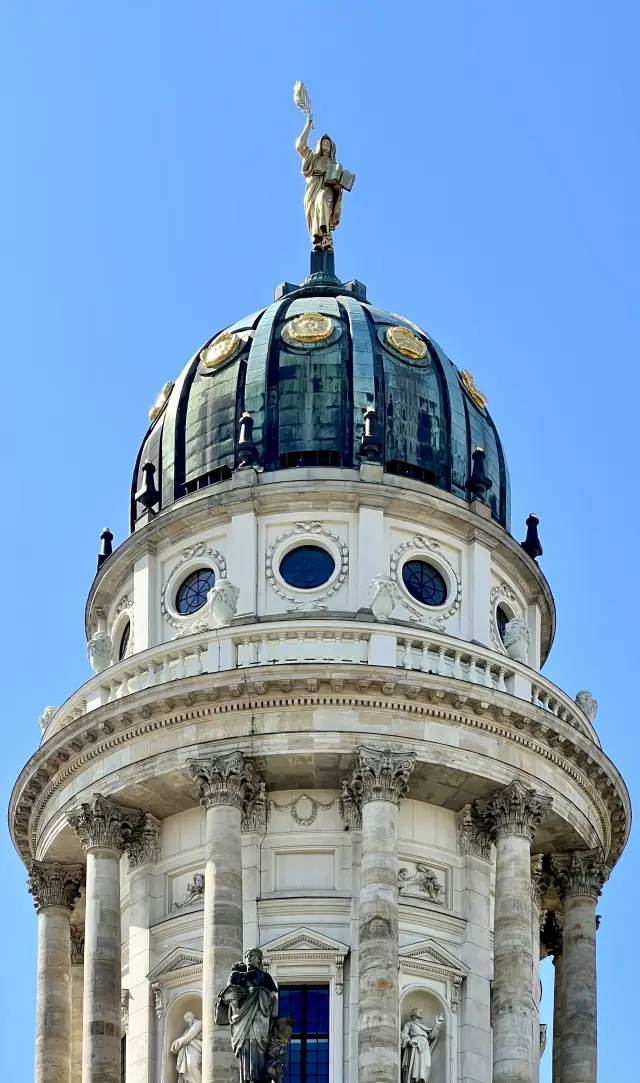
The rich sculptural decoration of the towers ranks among the most significant monumental figure programmes in German Protestant church architecture of the 18th century. The pediments of the French Cathedral show scenes from the life of Christ: Jesus and the Samaritan woman, the Sermon on the Mount and the walk to Emmaus.1 The tower has housed the Huguenot Museum since 1935; the highlight of its exhibition is the Edict of Potsdam, which guaranteed the Huguenots in Brandenburg-Prussia the free exercise of their faith. The tower also holds a carillon of 60 bronze bells — after the carillon in the Tiergarten the second-largest in the city.5
The tower you see today is largely reconstruction. On 24 May 1944 the dome of the tower burnt out, a few days after the nave had already been hit; a concrete ceiling inserted in 1930 saved the lower storeys. Between 1981 and 1987 the tower and dome were rebuilt and opened on 9 August 1987 for Berlin’s 750th anniversary — together with the carillon. The tower measures 60.58 metres, and the viewing balustrade is at around 40 metres.89
What you can see on site
The Gendarmenmarkt is accessible around the clock. The best view of both figures is in the early morning or the late afternoon, when the light falls at a low angle and the gold of the dome figure shines most strongly. The Schiller Monument can be viewed from close up: only on walking around the basin do the attributes of the four allegories reveal themselves — the harp of Lyric Poetry, History’s tablet with the three names, the mask at the feet of Tragedy.
Getting there and moving on
The Gendarmenmarkt lies centrally in Berlin-Mitte, on Französische Straße. The nearest underground stations are Stadtmitte (U2, U6) and Unter den Linden (U5, U6), both a few minutes’ walk away. From here both the Nikolaiviertel and the Brandenburg Gate are easy to reach on foot — both destinations are presented on the following pages of this guide.
History you can hear
Both figures of this square can now also be experienced in a voice of their own. Anyone wanting to know how Schiller looks upon his own monument and the four allegories at his feet, or how the dome figure describes her position above the square, can talk to both online — a complement to the visit on site, not a substitute for it.
Frequently asked questions
Who created the Schiller Monument and when was it unveiled?
Reinhold Begas, who prevailed over Rudolf Siemering in the competition in 1864. The foundation stone was laid on 10 November 1859, the marble figure was signed in 1869 and the monument was unveiled on 10 November 1871.46
Ask Schiller yourself →What do the four female figures on the Schiller Monument stand for?
For Lyric Poetry, Tragedy, History and Philosophy. Lyric Poetry plays the harp, Tragedy carries a dagger and a mask, History writes Lessing, Kant and Goethe on a tablet, and Philosophy holds a scroll reading “Know thyself”.6
Why was the Schiller Monument missing from the Gendarmenmarkt for more than fifty years?
In 1935/36 it was dismantled for the redesign of the square and badly damaged in the process. From 1951 the figure stood in the Lietzenseepark in West Berlin, while the allegories were stored in the Tierpark Friedrichsfelde in East Berlin. Only the cultural agreement of 1986 made the return in December 1988 possible.467
Is the golden figure on the French Cathedral a Nike?
Berlin calls her that; officially she is the allegory of triumphant Religion after designs by Daniel Chodowiecki, 5.60 metres high and wingless, and opposite on the German Cathedral stands Virtue.18 The raised palm branch is the ancient sign of victory, hence the nickname.
Ask Nike yourself →Sources and references
- Berlin State Monument Office (Landesdenkmalamt) — monument database, French Cathedral (object no. 09065017)
- Berlin State Monument Office (Landesdenkmalamt) — monument database, Schauspielhaus and history of the square (object no. 09065015)
- Berlin State Monument Office (Landesdenkmalamt) — monument database, Schauspielhaus (object no. 09065015)
- Berlin State Monument Office (Landesdenkmalamt) — monument database, Schiller Monument statue (object no. 09060093)
- French Cathedral and Huguenot Museum — visitor information
- Wikipedia (German) — Schiller-Denkmal (Berlin)
- Bildhauerei in Berlin — Schiller Monument (dimensions, material, locations)
- Mitte district office, memorial plaque database — French Tower, chronology and technical data (PDF)
- Wikipedia (German) — Französischer Dom