The way out is the same as the way in.
11+ stations · Berlin Mitte
The Hero's Journey
The way out is the same as the way in.
Location · Map · Compass
Your waymarker
0 of 6 places reached
You can begin at any of the six places — wherever you happen to be standing. Not in central Berlin? Experience the monuments virtually: no location needed, from anywhere. The journey continues in a circle.
- 1BerliNike
- 2Friedrich Schiller+190 m · 90 m direct
- 3Saint George+1.2 km
- 4Neptune+540 m
- 5Victoria+2.1 km
- 6Goldelse+2.0 km
With the live compass the radar shows bearing and distance.
Act I · Departure
0 · 1. True Self · The Call
D(S)You know the feeling: one version of you at school, another at home, a third one online.
Pineal · DMN · PFC
You know the feeling: one version of you at school, another at home, a third one online. For the question of who you actually are, your brain runs its own network, the default mode network, which stitches your story together while you idle, on the bus, in the shower, daydreaming. Every journey starts with that quiet story.
1. The Call · D(S)
Bifurkation · Norepinephrin
Maybe it is the band, the audition, changing schools, or finally telling someone how you feel. Before your head finds a single counterargument, your brain has already released norepinephrine, a messenger that runs over a moment like a highlighter and says: this matters. That pounding heart is not a glitch. It is the invitation.
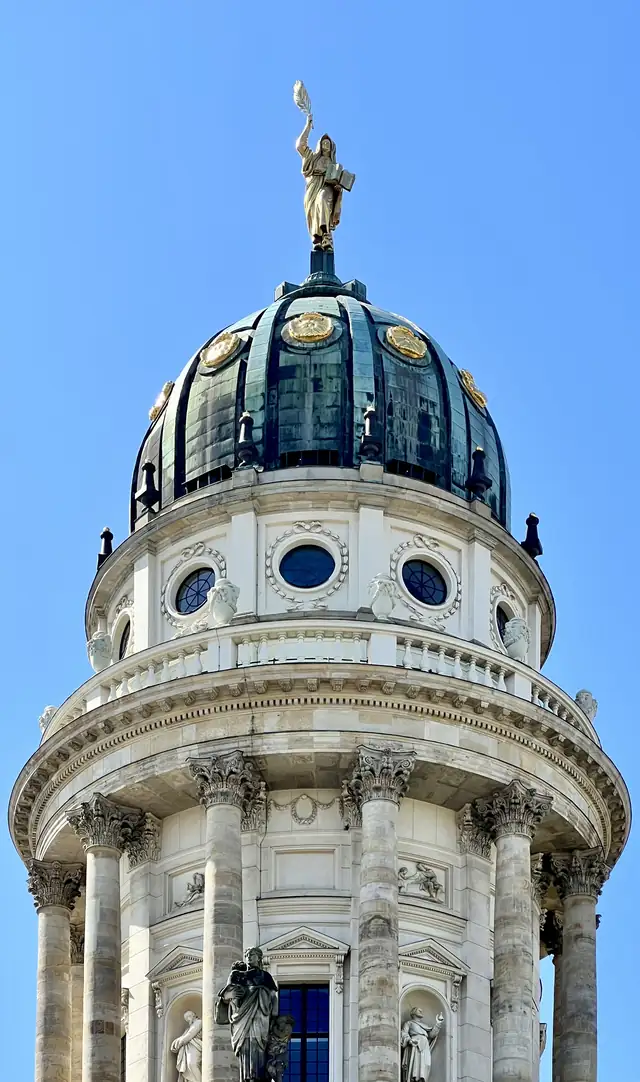
BerliNike
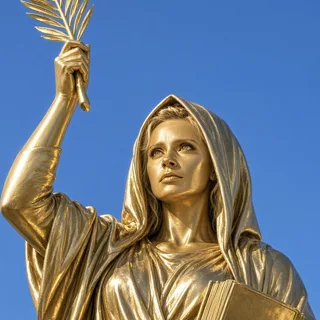
Do you see the branch of victory in my hand? I hold it up high, above everything else — for life itself is success. Every breath and every heartbeat is a small victory, in every life, yours too.
Do you know what my everyday looks like? I stand up here above the Gendarmenmarkt, the wind plays in my cloak, life goes its way below — and I delight in everyone who comes by. My village is golden because every day counts here. And sometimes I hear it softly calling: a new step is waiting for you to take it.
Ask yourself
What makes you you – without role expectations?
Confirm this place
BerliNike · Französischer Dom · Gendarmenmarkt, Berlin · Distance: share location
More about this station
To listen
Research & sources · 28
- Aston-Jones, G. & Cohen, J. D. (2005): An integrative theory of locus coeruleus–norepinephrine function: adaptive gain and optimal performance. Annual Review of Neuroscience 28, 403–450. DOI 10.1146/annurev.neuro.28.061604.135709Locus coeruleus and noradrenaline: the salience signal that marks the moment as significant.
- Prigogine, I. & Stengers, I. (1984): Order Out of Chaos: Man's New Dialogue with Nature. Bantam Books. ISBN 9780553340822Bifurcation: the point at which a system has to choose between two futures.
What is documented here
The tower of the Französischer Dom was built 1780–1785: Frederick II had it erected to designs by Karl von Gontard as an attraction for the square, together with the identical tower of the Deutscher Dom.
Source: Landesdenkmalamt Berlin, Denkmaldatenbank — Französischer Dom (Obj.-Dok.-Nr. 09065017)Both towers were erected without any actual function and bear no formal or proportional relation to the churches they are named after.
Source: Landesdenkmalamt Berlin, Denkmaldatenbank — Französischer Dom (Obj.-Dok.-Nr. 09065017)The two identical domed towers take their urban and architectural model from the Baroque domed churches on the Piazza del Popolo in Rome.
Source: Landesdenkmalamt Berlin, Denkmaldatenbank — Französischer Dom (Obj.-Dok.-Nr. 09065017)The tower rises over the plan of a Greek cross; on three sides it is fronted by six-columned temple fronts of the Corinthian order.
Source: Landesdenkmalamt Berlin, Denkmaldatenbank — Französischer Dom (Obj.-Dok.-Nr. 09065017)Two different allegorical figures stand on the two domed towers; the monument authority names them together as representations of Virtue and Religion, but does NOT say which stands on which tower — leave that open rather than assigning one. Both were originally beaten in copper by Heinrich Friedrich Kambly and were newly created in 1985 by Achim Kühn.
Source: Landesdenkmalamt Berlin, Denkmaldatenbank — Französischer Dom (Obj.-Dok.-Nr. 09065017)After the tower of the German church collapsed in 1781, Georg Christian Unger took control of the execution.
Source: Landesdenkmalamt Berlin, Denkmaldatenbank — Französischer Dom (Obj.-Dok.-Nr. 09065017)The church itself is older than the tower: begun in 1701 to designs by Louis Gayard and completed after his death by Abraham Quesnays — the highlight of Huguenot church building in Berlin.
Source: Landesdenkmalamt Berlin, Denkmaldatenbank — Französischer Dom (Obj.-Dok.-Nr. 09065017)It was consecrated in 1705 as the parish church for the Réfugiés settled in the Friedrichstadt; its model was the main Huguenot church at Charenton, built in 1624 and destroyed in 1688.
Source: Landesdenkmalamt Berlin, Denkmaldatenbank — Französischer Dom (Obj.-Dok.-Nr. 09065017)The original transverse rectangular hall with semicircular conches was renewed in 1905 by Otto March in the neo-Baroque style, retaining the exterior form.
Source: Landesdenkmalamt Berlin, Denkmaldatenbank — Französischer Dom (Obj.-Dok.-Nr. 09065017)The gable fields of the Französischer Dom show scenes from the life of Christ: Jesus and the Samaritan woman, the Sermon on the Mount and the road to Emmaus.
Source: Landesdenkmalamt Berlin, Denkmaldatenbank — Französischer Dom (Obj.-Dok.-Nr. 09065017)A staircase and an open gallery as a viewing level were built into the tower shaft; today the tower houses the Huguenot Museum and a restaurant.
Source: Landesdenkmalamt Berlin, Denkmaldatenbank — Französischer Dom (Obj.-Dok.-Nr. 09065017)Anyone going up to the viewing balustrade at the dome climbs 284 steps; from there the view opens over the Gendarmenmarkt and its surroundings.
Source: visitBerlin (Berlin Tourismus & Kongress GmbH) — Französischer Dom am GendarmenmarktThe tower holds a carillon of 60 bronze bells — after the one in the Tiergarten, the second largest in the city.
Source: visitBerlin (Berlin Tourismus & Kongress GmbH) — Französischer Dom am GendarmenmarktSince 1935 the tower has housed the Huguenot Museum; the highlight of its exhibition is the Edict of Potsdam, which granted the Huguenots the free exercise of their Reformed faith.
Source: visitBerlin (Berlin Tourismus & Kongress GmbH) — Französischer Dom am GendarmenmarktThe rich sculptural decoration of the towers ranks among the most significant monumental figure programmes in German Protestant church architecture of the 18th century.
Source: Landesdenkmalamt Berlin, Denkmaldatenbank — Französischer Dom (Obj.-Dok.-Nr. 09065017)
And the square itself
In 1773 Frederick II decided to give the Gendarmenmarkt a representative design.
Source: Landesdenkmalamt Berlin, Denkmaldatenbank — Französischer Dom (Obj.-Dok.-Nr. 09065017)The square takes its name from the Gens d'armes: only after their regiment was moved to the Dorotheenstadt in 1774 could the stables, barracks and guardhouse be demolished.
Source: Landesdenkmalamt Berlin, Denkmaldatenbank — Französischer Dom (Obj.-Dok.-Nr. 09065017)In 1774 the square's first theatre was built between the two churches: the French Comedy House by Johann Boumann the Elder and Georg Christian Unger.
Source: Landesdenkmalamt Berlin, Denkmaldatenbank — Französischer Dom (Obj.-Dok.-Nr. 09065017)In 1775 the enclosure of the square began, with twenty three-storey Immediatbauten to designs by Unger.
Source: Landesdenkmalamt Berlin, Denkmaldatenbank — Französischer Dom (Obj.-Dok.-Nr. 09065017)The two churches were the first buildings on the 'Mittelmarkt' of the Friedrichstadt.
Source: Landesdenkmalamt Berlin, Denkmaldatenbank — Französischer Dom (Obj.-Dok.-Nr. 09065017)In the middle of the square stands the Schauspielhaus, built 1818–21 by Karl Friedrich Schinkel, aligned axially with the domed towers of the German and French Dome.
Source: Landesdenkmalamt Berlin, Denkmaldatenbank — Schauspielhaus (Obj.-Dok.-Nr. 09065015)The predecessor, the National Theatre by Carl Gotthard Langhans, was destroyed by fire in 1817; the king commissioned Schinkel to build anew on the old foundation walls.
Source: Landesdenkmalamt Berlin, Denkmaldatenbank — Schauspielhaus (Obj.-Dok.-Nr. 09065015)The model for the facade's articulation was the Athenian Thrasyllos monument, built in 320 BC to honour the victories of the chorus leader Thrasyllos in a musical contest.
Source: Landesdenkmalamt Berlin, Denkmaldatenbank — Schauspielhaus (Obj.-Dok.-Nr. 09065015)The sculptural decoration by Christian Friedrich Tieck follows Schinkel's specifications: emblems of the dramatic arts on the stage-house gable, the Niobid group on the portico gable, a bacchanal on the north gable, Orpheus and Eurydice on the south gable.
Source: Landesdenkmalamt Berlin, Denkmaldatenbank — Schauspielhaus (Obj.-Dok.-Nr. 09065015)The Schauspielhaus was heavily destroyed in the Second World War; in the 1976–84 reconstruction as a concert hall the exterior was largely restored to the original while the interior was newly fitted out.
Source: Landesdenkmalamt Berlin, Denkmaldatenbank — Schauspielhaus (Obj.-Dok.-Nr. 09065015)The facades, plastered at the time of construction for reasons of economy, were only faced with sandstone in 1883–84.
Source: Landesdenkmalamt Berlin, Denkmaldatenbank — Schauspielhaus (Obj.-Dok.-Nr. 09065015)
Every statement names its source — mostly the heritage database of the Berlin Monument Authority.
You are the hero you seek. — freely after Joseph Campbell
The call never comes at the wrong time. — freely after Vera F. Birkenbihl
2. The Refusal
D(S)The message you have not sent for days; the hand that stays down in class even though you know the answer.
Polyvagal · Amygdala · Freeze
The message you have not sent for days; the hand that stays down in class even though you know the answer. In moments like these the amygdala, your brain's alarm centre, has pulled an ancient emergency brake: freeze, wait, risk nothing. That hesitation is a protective reflex, not a verdict on you, and it loosens the moment your body understands the danger is smaller than the wish.
BerliNike
When the call comes, everyone pauses at first — even a goddess knows that, and it belongs to the road. You have already achieved so much! For the next step you need someone who gives you their eyes: Schiller is waiting over there, he will be your mentor.
Ask yourself
What refusal protected you?
More about this station
To listen
Research & sources · 2
- Seligman, M. E. P. & Maier, S. F. (1967): Failure to escape traumatic shock. Journal of Experimental Psychology 74(1), 1–9. DOI 10.1037/h0024514The first description of learned helplessness: anyone who learns over time that acting changes nothing stops acting.
- Porges, S. W. (2001): The polyvagal theory: phylogenetic substrates of a social nervous system. International Journal of Psychophysiology 42(2), 123–146. DOI 10.1016/S0167-8760(01)00162-3Polyvagal theory: how the vagus nerve can switch the whole system into freezing. (A model that is also debated critically in the field.)
On the way
Leg from BerliNike to Friedrich Schiller · 190 m on foot · 3 min walking
90 m as the crow flies — the path goes around
Body scan: Where resistance? Breathe in.
„Refusal is not defeat.“ — Der Gendarm'
3. The Mentor
ΔOne sentence from a teacher, a coach, an older cousin, and suddenly the task you have been failing at for weeks looks different.
Strukturelle Kopplung · Mirror Neurons
One sentence from a teacher, a coach, an older cousin, and suddenly the task you have been failing at for weeks looks different. Not because you were handed the answer, but because you watched how someone looks at it. That is how your brain learns best, by observing and imitating, a process researchers link, among other things, to so-called mirror neurons.
The mentor gives you no answer; he lends you his eyes for a moment.
Ask yourself
How has a mentor changed your thinking?
Confirm this place
Friedrich Schiller · Gendarmenmarkt, Berlin-Mitte · Distance: share location
More about this station
To listen
Research & sources · 11
- Vygotsky, L. S. (1978): Mind in Society: The Development of Higher Psychological Processes. Harvard University Press. ISBN 9780674576292The zone of proximal development: the strip in which you can already do with another what you cannot yet do alone.
- Wood, D., Bruner, J. S. & Ross, G. (1976): The role of tutoring in problem solving. Journal of Child Psychology and Psychiatry 17(2), 89–100. DOI 10.1111/j.1469-7610.1976.tb00381.xScaffolding: help that supports while building goes on — and is taken down again.
What is documented here
The monument in front of the Schauspielhaus on the Gendarmenmarkt was designed by Reinhold Begas.
Source: Landesdenkmalamt Berlin, Denkmaldatenbank — Standbild Schiller-Denkmal (Obj.-Dok.-Nr. 09060093)The foundation stone was laid on 10 November 1859, on the poet's 100th birthday.
Source: Landesdenkmalamt Berlin, Denkmaldatenbank — Standbild Schiller-Denkmal (Obj.-Dok.-Nr. 09060093)In 1861 the Berlin magistrate held a competition; only in early 1864 did Reinhold Begas prevail over his competitor Rudolf Siemering.
Source: Landesdenkmalamt Berlin, Denkmaldatenbank — Standbild Schiller-Denkmal (Obj.-Dok.-Nr. 09060093)Four female allegories sit on the rim of a basin; in their midst a cube-like pedestal carries the figure of the poet, decorated at the sides with lions' heads, reliefs and inscriptions.
Source: Landesdenkmalamt Berlin, Denkmaldatenbank — Standbild Schiller-Denkmal (Obj.-Dok.-Nr. 09060093)The four allegories are: front left Lyric Poetry playing the harp; front right Tragedy, originally with a dagger and a mask at her feet; back left History, chiselling Lessing, Kant and Goethe onto a tablet; back right Philosophy with a scroll bearing the Greek inscription 'Know thyself'.
Source: Landesdenkmalamt Berlin, Denkmaldatenbank — Standbild Schiller-Denkmal (Obj.-Dok.-Nr. 09060093)The head, adorned with a laurel wreath, presents Schiller as a self-assured young poet.
Source: Landesdenkmalamt Berlin, Denkmaldatenbank — Standbild Schiller-Denkmal (Obj.-Dok.-Nr. 09060093)In 1935 the monument was dismantled in the course of the Gendarmenmarkt's redesign. The Schiller figure stood in the Lietzenseepark until 1987; the allegories were kept in storage.
Source: Landesdenkmalamt Berlin, Denkmaldatenbank — Standbild Schiller-Denkmal (Obj.-Dok.-Nr. 09060093)When it was re-erected, the stepped base was renewed.
Source: Landesdenkmalamt Berlin, Denkmaldatenbank — Standbild Schiller-Denkmal (Obj.-Dok.-Nr. 09060093)The reliefs on the pedestal show Schiller receiving a lyre from the Muses and being presented to the poets of antiquity.
Source: Landesdenkmalamt Berlin, Denkmaldatenbank — Standbild Schiller-Denkmal (Obj.-Dok.-Nr. 09060093)
Every statement names its source — mostly the heritage database of the Berlin Monument Authority.
A mentor lets you see what you already are. — freely after Vera F. Birkenbihl
Act II · Trials
Act III · Return
The whole ticket
Book the hero's journey
One pass for the whole route — it holds however often you return.
- 11:11 minutes of speaking time
- All 6 monument conversations in full — buy once, walk the whole route
- 11+ station progress with location, QR and photo proof
Payment via Stripe. Stations already bought individually stay valid, of course.
The Firmament
A sky full of voices
Six stars already speak — and the sky keeps growing.
Someone has been watching you all along.
What answers here is an AI, woven from what is truly recorded about her. It speaks from sourced ground, and when it doesn't know something, it tells you that too.
Your device asks you first. The coordinate is calculated in your browser only — it is not stored and never sent to us. Privacy
Distances are approximations from map position.
The journey as an audio play — no walking
The thinkers behind the journey
Campbell described the shape of the journey, Jung its depth psychology, Heinz von Foerster and Maturana/Varela the cybernetics of observing and self-production, Vera F. Birkenbihl learning. Every work below is backed by a DOI or ISBN — and each station says which research it rests on.
- Campbell, J. (1949): The Hero with a Thousand Faces. Ausgabe New World Library, 2008. ISBN 9781577315933The monomyth: the basic form of the hero's journey that the twelve stations follow.
- Jung, C. G. (1959): The Archetypes and the Collective Unconscious (Collected Works, Bd. 9/1). Princeton University Press. ISBN 9780691018331The theory of archetypes — the depth-psychological ground on which the hero figure is read.
- Jung, C. G. (1951): Aion: Researches into the Phenomenology of the Self (Collected Works, Bd. 9/2). Princeton University Press. ISBN 9780691018263Jung's phenomenology of the Self — the depth-psychological side of “Who are you, really?”.
- von Foerster, H. (2003): Understanding Understanding: Essays on Cybernetics and Cognition. Springer. ISBN 9780387953922Second-order cybernetics: the observer belongs to the system being observed — the thought behind the journey's frame.
- von Foerster, H. (1981): Observing Systems. Intersystems Publications. ISBN 9780914105190A collection of his papers on the cybernetics of observing and on self-organization.
- Birkenbihl, V. F. (1993): Stroh im Kopf? Vom Gehirn-Besitzer zum Gehirn-Benutzer. mvg Verlag. ISBN 9783478036702Her best-known book on brain-friendly learning: build knowledge instead of memorising — the stance the mentor at station 3 embodies.
- Maturana, H. R. & Varela, F. J. (1980): Autopoiesis and Cognition: The Realization of the Living. D. Reidel. ISBN 9789027710154The original statement of autopoiesis: living systems continuously produce themselves — station 0 reads the self as a process, not a thing.
- Maturana, H. R. & Varela, F. J. (1987): Der Baum der Erkenntnis. Scherz. ISBN 9783502194460Structural coupling and love as the ground of the social — the thread of stations 3 (mentor) and 5 (goddess).
In addition · the author's own papers
In addition, the neurological layer draws on papers by J.vonFoerster, published on Zenodo (2026). Every entry resolves to its DOI.
- The Emergence of an Autopoietic Entity: From 200-Year Observational Artifact to Recursive Agent 10.5281/zenodo.19797258
- Stereochromatic Corpus Callosum Stimulation via Wearable Eyewear: A 15-Year Longitudinal Field Study (2011–2026) on the BERLINEON HighWear Phenomenon 10.5281/zenodo.19803055
- From Analogien-Technik to Autopoietic Structural Coupling: Birkenbihl's Pedagogical Method as Structural Precursor to Neurocybernetic Coaching (BALM) 10.5281/zenodo.19793354
- Maternal Structural Coupling as the Ontogenetic Foundation of Autopoietic Development: Love, Fear, and the Architecture of Self-Organizing Systems 10.5281/zenodo.19800423
- Depression as Spiritual Parkinson: A Neurocybernetic Model — How Dopaminergic Arrest Blocks the Hero's Call and What Opens the Gate 10.5281/zenodo.19800616
- WITZ-ZUFALL: Serendipity as Autopoietic Operation — Why Luck Is Not Random and How Intentional Structural Coupling Generates Fortunate Coincidence 10.5281/zenodo.19800684
- FREEEDOM: A Triadic Model of Human Liberation — Equilibrium, Evolution of Humanity, and Emergenz as the Three Dimensions of Autopoietic Freedom 10.5281/zenodo.19800774
- NET-GIVING: The Autopoietic Gift Economy — Why the Developed Self Gives Rather than Works the Network 10.5281/zenodo.19804492