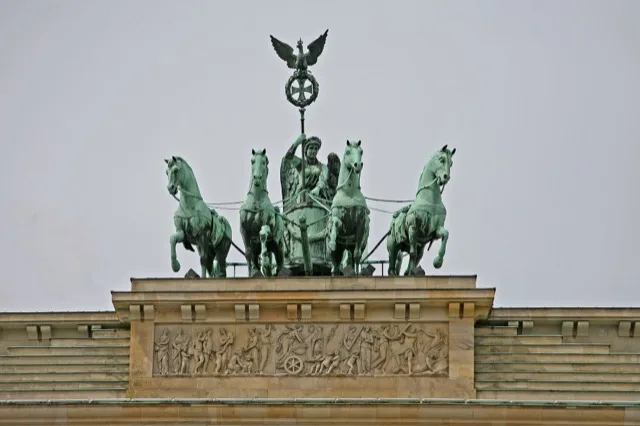
Between Pariser Platz and the Großer Stern lie around two kilometres of Straße des 17. Juni — and at each end stands a goddess of victory. On the Brandenburg Gate, Victoria drives her Quadriga eastwards into the city; at the other end of the Tiergarten stands Goldelse, Friedrich Drake’s gilded Victoria, high above the Großer Stern. The same Roman goddess, two Berlin figures — and two very different stories of what a monument in this city has had to endure.
The Gate and its goddess
Friedrich Wilhelm II had the first plain pillared gate replaced between 1789 and 1791 by a prestigious new building by Carl Gotthard Langhans; the model was the Propylaea, the monumental entrance to the Acropolis of Athens. The still unfinished Gate was opened on 6 August 1791 as a gate of peace — it is one of the earliest buildings of Berlin Classicism and the only surviving city gate in Berlin.1
The Quadriga with the goddess of victory is by Johann Gottfried Schadow; it was executed in copper by Emanuel Jury between 1790 and 1793.1 Beaten, not cast: a bronze casting would have been too heavy for the Gate, so the group was made of sheet copper over a wooden model.2 That the figure is Victoria is stated in the records of her creation — a minute of 1789 refers to “the Victoria”, and from 1791 the coppersmith received payments “for the copper figure Victoria”.3 On 11 July 1793 the King decided against gilding; that same summer the Quadriga stood on the Gate.3
- 1789On 13 March a conference approves Schadow’s model at a scale of 1:8.
- 1793The Quadriga is anchored on the Gate; the King forgoes gilding.
- 1806After Napoleon’s entry on 27 October, the Quadriga is taken down in December and carried to Paris in twelve crates.
- 1814Return after the Wars of Liberation; on 7 August it stands on top again, supplemented by Schinkel’s oak wreath with the Iron Cross and the Prussian eagle.
- 1942Protective plaster cast of horses and goddess.
- 1945In the Battle of Berlin the Quadriga is largely destroyed; a single horse’s head survives.
- 1957 – 1958Recreation from the plaster cast by Otto Schnitzer, cast at Hermann Noack in Friedenau; finished on 14 December 1957, installed in 1958.
- 1958During the night before 3 August, the eagle and the Iron Cross are removed.
- 1991 – 1992Restoration; the Iron Cross and the eagle return.
Loot, return, destruction, recasting
In 1806 the Gate became a scene of history for the first time: as a triumphal arch for Napoleon’s entry.1 In December of the same year he had the Quadriga taken down and carried to Paris — in twelve crates that left on 21 December and arrived in May 1807.3 It remained there for nine years. After the Wars of Liberation it returned in 1814, was restored at the Grunewald hunting lodge and stood on top again on 7 August. When it was reinstalled, Karl Friedrich Schinkel added an Iron Cross and a Prussian eagle within an oak wreath.13
The Second World War left almost nothing of the Quadriga: a single horse’s head, today in the Märkisches Museum.32 That it exists again is owed to a protective plaster cast of 1942. The East Berlin Magistrat resolved on the reconstruction in 1956, Otto Schnitzer took it on, and the casting was done at the Hermann Noack foundry in Friedenau — in West Berlin, on behalf of East Berlin. On 14 December 1957 the group was finished, and in 1958 it stood on the Gate again.3 During the night before 3 August 1958 the eagle and the Iron Cross were removed, as “emblems of Prussian-German militarism”. In the restoration after 1990 the standard that had been sawn out in 1958 was reinserted.13
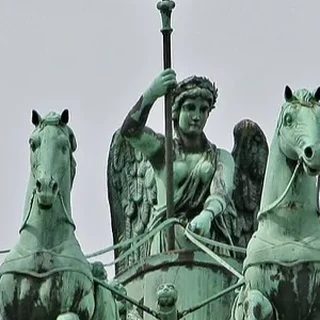 VictoriaThe goddess of victory on the Quadriga atop the Brandenburg Gate.Talk to the figure →
The Victory Column: built for one war, dedicated to three
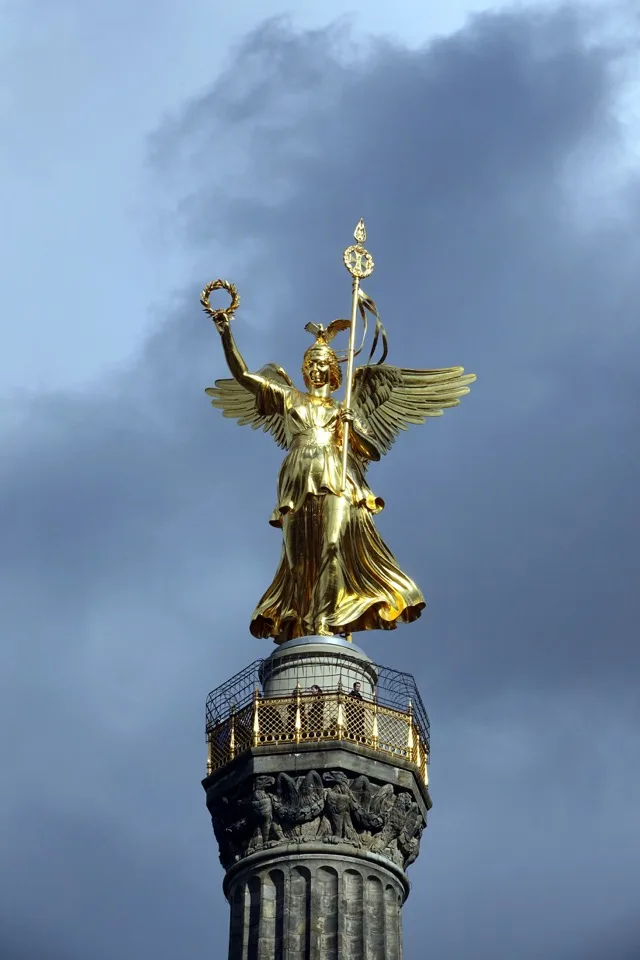
At the other end of the axis stands the Victory Column. It was erected between 1865 and 1873 and stood until its relocation in 1938/39 on the Königsplatz, today’s Platz der Republik in front of the Reichstag. The column monument was originally intended as a token of victory in the Danish campaign of 1864 and became, through the wars against Austria in 1866 and France in 1870/71, a monument to three wars.4 The design is by Heinrich Strack, who took ancient Roman column monuments as his model; gilded captured cannon barrels from Denmark, Austria and France are mounted in the flutes of the shaft.4 It was inaugurated on 2 September 1873, Sedan Day.5
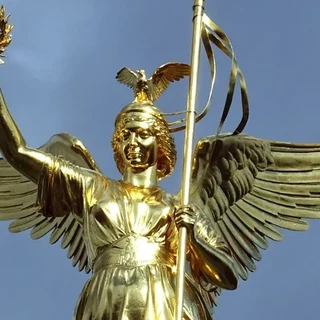
The sculptor Friedrich Drake created the gilded Victoria that crowns the monument above the octagonal viewing platform: a winged goddess of victory in a robe billowing in the wind, with a victor’s wreath and a standard; with her Prussian eagle helmet she is to be understood as Borussia at the same time.4 She measures 8.32 metres and weighs around 35 tonnes.5 She owes her nickname to the gilding and to a serialised novel: E. Marlitt’s “Goldelse” appeared in the “Gartenlaube” in 1866.56
- 1864Heinrich Strack designs the column after the victory in the Danish campaign.
- 1873Inauguration on 2 September on the Königsplatz; 60.5 metres high.
- 1876The glass mosaic after Anton von Werner, from the Salviati workshop in Venice, is installed.
- 1938 – 1939Relocation to the Großer Stern to plans by Albert Speer; the shaft receives a fourth drum, the base is widened, the square enlarged from 80 to 200 metres in diameter.
- 1945The column survives the war largely intact; the base reliefs are removed and taken to France.
- 1946On 26 November France applies for the column’s demolition — without success.
- 1987The reliefs return and are reinstalled.
- 2010 – 2011The most extensive restoration; Victoria is regilded with around 1.2 kilograms of gold leaf.
1938/39: not destroyed, but enlarged
The column has a history that differs from all the others in this guide. No enemy stole it, no war took it apart. It was relocated because the Königsplatz was to be turned, to plans by the Inspector General of Buildings Albert Speer, into a vast parade ground; Speer used it as a landmark, visible from afar, of his expanded east-west axis. To improve the urban effect, he had the base widened and the shaft raised by a fourth column drum.4 From 60.5 metres it became just under 67; the Großer Stern grew from 80 to 200 metres in diameter, and along with the column the monuments to Bismarck, Moltke and Roon also moved here from the Königsplatz.457
On the four sides of the base, bronze reliefs by Alexander Calandrelli, Carl Keil, Moritz Schulz and Albert Wolff tell the story of the Wars of Unification; they were removed after 1945 and reinstalled in 1987.4 Strack designed the columned hall after the model of the Große Neugierde in the palace park at Glienicke, a building by Schinkel; around the inner shaft runs a mosaic to drawings by Anton von Werner, made in Venice.4
What you can see on site
The Brandenburg Gate is accessible at all times; the Quadriga is best seen from Pariser Platz, with the sun behind you in the morning. The reliefs on the gatehouses are worth a look: on the northern gatehouse the war god Mars sheathes his sword, while on the south side Minerva embodies craft and industry.1
Getting there and moving on
The Brandenburg Gate is reached via the S-Bahn and U-Bahn station of the same name (S1, S2, S25, U5). From there, Straße des 17. Juni leads straight through the Tiergarten to the Großer Stern, a good two kilometres on foot through the 210-hectare park, which was redesigned by Peter Joseph Lenné between 1833 and 1840.8 If you want to return to the Gendarmenmarkt, take the U5 from Brandenburger Tor to Unter den Linden.
History you can listen to
Victoria and Goldelse tell their stories on berlinike.art in their own voices — one of Paris, of the horse’s head and of the recasting, the other of what it means to have been made bigger by her own side. A complement to the visit on site, not a substitute for it.
Frequently asked questions
Who created the Quadriga on the Brandenburg Gate?
It was designed by Johann Gottfried Schadow; it was executed between 1790 and 1793 by the coppersmith Emanuel Jury — beaten in copper rather than cast, because bronze would have been too heavy for the Gate.12
Ask Victoria yourself →Is today’s Quadriga still the original?
No. The original was largely destroyed in the Battle of Berlin in 1945; only one horse’s head survived and is today in the Märkisches Museum. The present group was made in 1957/58 from a plaster cast of 1942 at the Hermann Noack foundry.3
Why is the figure on the Victory Column called Goldelse?
Because of her gilding and a serialised novel: E. Marlitt’s “Goldelse” appeared in the “Gartenlaube” in 1866. Friedrich Drake’s Victoria is 8.32 metres high and weighs around 35 tonnes.56
Ask Goldelse yourself →Why does the Victory Column stand at the Großer Stern?
How many steps does the Victory Column have?
285 steps lead to the viewing platform at a height of 50.66 metres; access is through the pedestrian tunnels beneath the roundabout.5
Sources and references
- Berlin State Monument Office (Landesdenkmalamt) — monument database, Brandenburg Gate (object no. 09065019)
- Bildhauerei in Berlin — Quadriga on the Brandenburg Gate
- Wikipedia (German) — Brandenburger Tor
- Berlin State Monument Office (Landesdenkmalamt) — monument database, Großer Stern with Victory Column (object no. 09050419)
- Mitte district office, memorial plaque database — The Berlin Victory Column (PDF)
- Wikipedia (German) — Berliner Siegessäule
- Mitte district office, memorial plaque database — The relocation of the Victory Column in 1938/39 (PDF)
- Wikipedia (German) — Großer Tiergarten