
1888 – 1891 · seit 1969 am heutigen Standort
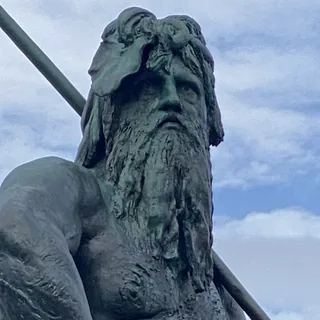
Neptune
The sea god between the Rathaus, Marienkirche and TV Tower
Talk live
First 1:11 minutes free — with a real voice
Tap to start the conversation
Start conversation — free
111 messages on the house — write as much as you like
Talk to Neptune at the fountain between the Red City Hall and the TV Tower — the sea god who was carried off for 18 years after the City Palace was demolished, before landing here.
Spandauer Straße, Berlin-Mitte
Neptunbrunnen (Reinhold Begas, 1888–1891), zwischen Rotem Rathaus, Marienkirche und Fernsehturm · Spandauer Straße, 10178 Berlin-Mitte · 1888–1891 · seit 1969 am heutigen Standort
True autopoiesis from our history — an AI embodiment, grounded in documented work and imagery.
BerliNike.Art · A living monument
Documented basis· 4
Each of these statements appears on the site of the institution that owns the object, or of the responsible public body. The link leads to the source.
According to tradition, Neptune is the son of Saturn; swallowed by his father, he was brought back to light through an emetic that Jupiter gave Saturn.
Original wording of the source (German) „Sohn des Saturnus und der Rhea , von seinem Vater verschlungen, jedoch durch das Brechmittel, das demselben Jupiter beibrachte, wieder an's Licht gebracht."
Note: Der Quelltext nennt die Mutter „Rhea“ (griechisch) statt der römischen Ops — Vollmers Lexikon vermischt an dieser Stelle griechische und römische Mythologie ('Gr. u. röm. M.'). Deshalb bleibt die Mutter hier unerwähnt.
Source: Vollmer, Wilhelm: Wörterbuch der Mythologie. Stuttgart 1874, S. 345f. — Zeno.org · verified 2026-08-17
In the battle against the Titans, Neptune received the earthquake-causing trident as a gift from the Cyclopes.
Original wording of the source (German) „Er bekämpfte siegreich die Titanen und ward von den Cyclopen mit dem erderschütternden Dreizack beschenkt"
Source: Vollmer, Wilhelm: Wörterbuch der Mythologie. Stuttgart 1874, S. 345f. — Zeno.org · verified 2026-08-17
According to tradition, after rebelling against Jupiter together with Apollo, Neptune was banished to earth for a year.
Original wording of the source (German) „als er sich jedoch später mit Apollo gegen Jupiter empörte, ward er auf"
Note: Satz geht über einen Seitenumbruch im Faksimile weiter: „...ein Jahr zur Erde verbannt.“
Source: Vollmer, Wilhelm: Wörterbuch der Mythologie. Stuttgart 1874, S. 345f. — Zeno.org · verified 2026-08-17
Although poets and artists mostly depict him as god of the sea, Neptune is more broadly regarded as god of waters in general — of rivers and springs; the horse is his attribute.
Original wording of the source (German) „Obgleich übrigens bei den Dichtern und Künstlern die Vorstellung von N. als dem Meergotte vorherrscht, so wird er doch im weitern Sinne als Gott der Gewässer überhaupt, der Flüsse und Quellen gedacht, und ihm daher das Pferd als Attribut zugesellt"
Source: Vollmer, Wilhelm: Wörterbuch der Mythologie. Stuttgart 1874, S. 345f. — Zeno.org · verified 2026-08-17
The Sound of the Era
Water Music — Alla Hornpipe · Georg Friedrich Händel, 1717
Music composed for a royal barge trip on the Thames — sounding water: the sea god's element at his fountain.
Recording: U.S. Marine Band · Public Domain
More voices in Berlin